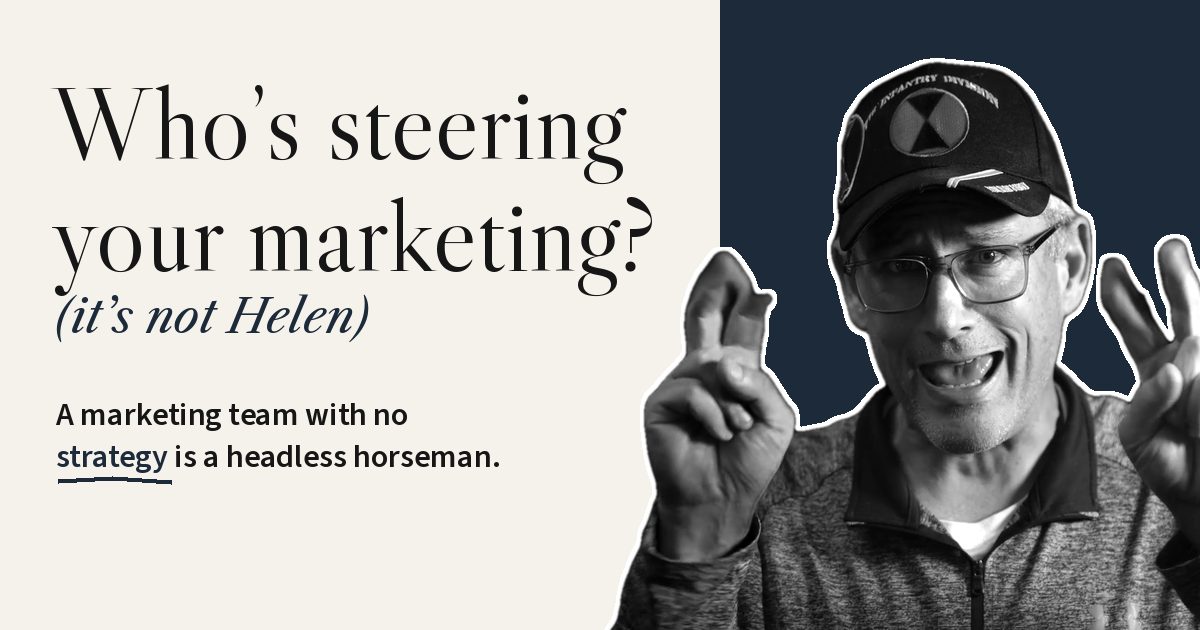
A marketing team with no strategy stays busy all year and still can’t tell you what it brought in. At Big Brain Strategy we call this pattern the headless horseman. This post is for owners with one or two junior marketers who report to someone outside marketing. It covers how it happens, what it costs, and how to fix it.
The short answer: A marketing team with no strategy is usually one or two junior people reporting to someone who isn’t a marketer. With no senior leader setting goals and priorities, the team takes requests from everyone, the loudest one goes first, and nothing ties back to revenue. The fix is a senior marketing leader, full-time or part-time, who owns the plan.
Rather read it? Jump to the full video transcript.
What is a headless horseman marketing team?
A headless horseman marketing team works hard with nobody steering. There’s no strategy and no goals, nobody guiding the work, and nobody developing the people doing it.
Picture the horse at full gallop. The rider is whoever is in charge of marketing: the head of sales, someone in HR, or the owner. The rider has no head, so there’s a lot of frantic activity on that horse and no idea where it’s headed. Your marketing people are running alongside, trying to keep up.
The team isn’t the problem. They’re running without a map. That’s what tactics without strategy looks like, and it’s the gap we cover in marketing strategy vs. marketing tactics.
What does a week look like for a marketing team with no strategy?
A marketing team with no strategy spends the week filling requests from every department. Here’s a typical one:
- Monday: sales wants a new deck.
- Tuesday: the owner is speaking at a chamber breakfast tomorrow morning and needs a deck right now.
- Wednesday: HR says the company won an award, so marketing needs to write a press release today for the three people who still read those.
- Thursday: sales wants the deck changed. The font needs to pop more.
- All week: the owner looked at social media and wants the company to go viral, look more fun, and sound like the Wendy’s Twitter account, but on brand, without offending anyone, and only after every department head approves every post.
From the owner’s office, it all looks great. Every time they walk by, the marketing team is working on something. But busy is the only thing the business is getting.
How do small businesses end up with a marketing team with no strategy?
Most small businesses end up here through a series of reasonable decisions. They know they need marketing, and a senior marketer costs real money, so they hire someone young who’s good with Canva and posts on Instagram. Small teams are normal: in an Act-On survey of marketers, 85% said their team had 10 people or fewer, and nearly two-thirds had one to five.
The new hire has to go somewhere on the org chart, so they end up under HR or under sales. Helen in HR might be great at HR. Your head of sales might be great at selling. Neither one is a marketer, and neither one has time to lead marketing on the side.
So the marketing person turns into the company’s in-house print shop. Whoever asks gets served, and whoever asks the loudest gets served first.
What does a marketing team with no strategy cost you?
A marketing team with no strategy costs you two things: results you can’t measure, and your belief that marketing works at all.
Nobody can tell you what any of it did. Every request got done, but none of it was connected to a plan, so none of it was connected to revenue. You can’t pay the bills with a nice-looking deck or a press release that three people read. If you can’t trace the work back to someone buying from you, you’re paying people to stay busy.
You decide marketing doesn’t work. “We had two people on it full time, and it did nothing but waste money.” The truth is that marketing never got a fair shot. It was everyone’s assistant.
It wears the team down too. In Marketing Week’s 2026 Career & Salary Survey of 2,350 marketers, 55.1% said they felt emotionally exhausted and 60.7% felt undervalued. A junior marketer buried in task after task, with nobody to push back for them, is a good way to end up hiring their replacement.
How do you fix a marketing team with no strategy?
You fix a marketing team with no strategy by putting a rider on the horse who can see where it’s going. That comes down to three things.

1. Put someone senior in charge of marketing
Somebody senior has to own marketing. For most small businesses, a full-time senior marketer isn’t affordable, but you still need one, so a part-time marketing leader makes sense. HR, sales, and the owner all have their own jobs and can’t lead marketing on the side. If you’re weighing that option, here’s what a part-time CMO actually does.
Leading the team also means developing the people on it. Somebody has to train your junior marketers and show them what good looks like. It isn’t fair to a young team when nobody ever mentors them.
2. Prioritize every request against a plan
Every request gets checked against the plan. The question is simple: does this help us get seen, get remembered, get trusted, or get purchased? Those are the Four Gets, and a request that helps with one of them goes to the front of the line. Not every request ties straight to money, so the leader still decides what comes first.
3. Give the team a shield
The most valuable thing a senior leader does for a small marketing team is stand in front of it. Every request comes through one front door, and that’s the leader. Sales doesn’t get to walk up to someone’s desk and drop a new deck on them.
The leader sees every request coming in, decides what gets done and when, and gives every piece of work an owner and a date. The leader can also say no to the other leaders in the building. The new hire won’t. They don’t know how, they’re afraid to, and they want to be helpful.
A no from the leader usually isn’t a no forever. The owner needs something this week? It can happen, and here’s what moves so it gets done. Sales wants the deck changed again? It’s on the list for next Tuesday. Meanwhile, the junior team stays focused on the work that brings in sales.
What we’ve seen
I’ve built marketing departments from the inside. As partner and CMO at Grunt Style, I built a 75-person marketing team and managed a $16M annual marketing budget while the brand grew from $6M to $80M. The first thing a team like that needs is someone deciding what matters, in what order, and why. Adding people comes later.
When we step into a headless horseman situation, the junior people are rarely the problem. They’re usually working harder than anyone in the building. What changes is the structure around them: one plan, one front door for requests, and someone with the experience and authority to say “next Tuesday.”
If you want to check your own team this week, ask everyone what marketing is supposed to accomplish this quarter. Write down each answer. If they don’t match, you’ve found the problem.
Frequently asked questions
Most small businesses don’t need a full-time CMO, and can’t afford one. They do need someone senior who owns the marketing plan, sets priorities, and manages the team. A part-time marketing leader can do that for a fraction of the cost, while junior staff or vendors handle the day-to-day work.
A small marketing team should report to someone who has led marketing before. When the team reports to HR, sales, or an owner with no marketing background, it ends up taking orders from every department. If nobody on staff has that experience, bring in a part-time senior leader.
Your marketing team probably has no strategy if it stays busy but nobody can say what it brought in, if priorities change with the latest or loudest request, or if different leaders give different answers about what marketing is supposed to do. Those are the signs of the headless horseman pattern.
No. A <a href=”https://bigbrainstrategy.com/marketing-patterns/the-firefighter/”>Firefighter</a> business is always reacting, and every week starts from zero. A headless horseman has steady output and a busy team, but nobody senior deciding which work matters. The two often show up together.
Find out who’s steering
If your marketing team is busy and you can’t see what it’s producing, start with The Headless Horseman pattern. Or send us your site for a free marketing teardown: Mike or Nada will record a 10-minute video with the three things we’d fix first.
Video transcript
The full transcript, lightly edited for reading. Timestamps jump to that spot in the video.
Show the full transcript (about 5 minutes to read)
0:00 Marketing team with no strategy? The headless horseman
He’s got a Roblox account, and he posts on the Instagrams. So let’s make him our head of marketing.
If your marketing team is busy all the time, but you don’t know if they actually bring in sales, you’ve probably got a headless horseman. That’s a marketing team with no strategy or goals. There’s no direction. Nobody’s guiding the team, and nobody’s developing them. What’s missing is leadership.
Usually, a marketing team in a headless horseman organization has one or two junior people, and they report to somebody who isn’t a marketer. That might be the head of sales, or it could be HR, or it could be you. That person is the rider, and the rider has no head. There’s a lot of frantic activity happening on the horse, but they have no idea where it’s leading them. And your marketing team? They’re just running alongside the horse, trying to keep up.
0:49 A week in the life of a marketing team with no leader
Here’s what a week looks like for a marketing team at a headless horseman organization. On Monday, sales wants a new deck. Okay, no problem.
On Tuesday, the owner comes in saying they’re speaking at a chamber breakfast tomorrow morning. “And I need a new deck right now, so drop everything.” Great.
On Wednesday, HR comes in and says the company won a fancy award. “So, marketing, you need to write a press release to announce it.” To the three people who still check those things. “Oh, also, we need that today.”
And then sales comes back. Now they want a change to the deck. They need the font to pop more.
And then on top of all that, the owner just looked at social media and is now telling the team, “Hey, we need to blow up on social media, and we’ve got to go viral. Oh, and make sure we look more fun too. But also make sure every post is approved by me and every department head. Oh, and make us sound like the Wendy’s Twitter account. Have you ever seen them? They’re hilarious. But don’t do exactly like them. Be funny. Yes, but be on brand funny. And make sure you don’t offend anybody, ever. But again, be funny. Oh, and where’s that deck I need for my talk tomorrow?”
As the owner, this all looks great, right? Every time you walk by, the marketing folks are busy doing something. “Well, they better be,” you say. “We pay good money for marketing, so they better be busy.” Busy is the only thing you’re getting.
2:09 How small businesses end up with a headless horseman
So how did you end up here? Well, you knew you needed marketing, but a senior marketer costs real money, and there’s no way you were going to do that. Your nephew just graduated, though, and he needs a job. Plus, he’s got a Roblox account, and he posts on the Instagrams. So let’s make him our head of marketing.
And he had to go somewhere on the org chart, so he ended up under Helen in HR, maybe. Or maybe he’s under sales. Now, look, Helen might be a great HR person, or your head of sales might be great at selling, but neither one of them is a marketer.
So now your marketing person turns into the company’s in-house print shop. Whoever asks gets served, and whoever asks the loudest gets served first.
2:48 What a busy marketing team with no plan costs you
So what does that cost you? First, nobody can tell you what any of it did. Every request might have gotten taken care of, but none of them were connected to a plan, so none of them were connected to revenue. You can’t pay your bills with a nice-looking deck or a press release that three people read.
Second, you decide marketing just doesn’t work for you. “We had two people on it full time, and it did nothing but waste money.” The truth is, though, your marketing never really got a fair shot, and it wasn’t actually marketing. Those marketing people were just everyone’s assistant.
So how do you fix it? You’ve got to put a rider on the horse who can see where they’re going. That comes down to three things.
3:26 Why a part-time marketing leader makes sense
First, somebody senior has to own marketing. And for most businesses this size, that’s where a part-time or a fractional hire makes sense. You can’t afford a senior marketer full time, and you don’t need one. But you do need one at least part-time.
Helen in HR might mean well, but she can’t lead marketing on the side. And leading teams means developing the people on them. Is it fair to your young team members that nobody’s ever mentoring them at all? A fractional leader fills that gap. They manage the team, and they develop them.
3:55 How to prioritize marketing requests
Second, there’s a plan, and every request gets prioritized against it. Does it help us get seen, get remembered, get trusted, or get purchased? Then it goes to the front of the line.
4:08 Why your marketing team needs a shield
And third, and this might be the most valuable thing a senior leader does, they are a shield for your team. Every request comes through one front door, and that’s the leader. Sales doesn’t get to walk up to somebody’s desk and drop a new deck on them. The leader decides what gets done and when, and everything that gets done has an owner and a date.
That leader can also say no to other leaders in the building. The new kid is likely not going to do that. They don’t know how, they’re afraid to, and honestly, they just want to be helpful, so they’re not going to say no to anything.
And for a senior leader, saying no doesn’t mean it’s a forever no. Senior leaders will look at these requests and figure out how to prioritize them, or figure out what needs to happen so everyone can get what they need while the work of marketing is still getting done.
So the owner needs something this week? Great. Okay, here’s what moves so we can get it done. Sales wants the deck changed again? Okay, it’s on the list for next Tuesday. And we’re going to keep the junior folks focused on the work that matters.
5:06 Stop judging marketing by how busy it looks
So stop judging your marketing people by how busy they look. Put someone senior in charge. Give them a plan tied to money, and let them say no if they need to.
If your marketing needs a rider who can see where it’s going, that’s what I do. I’ve been a fractional CMO. I’ve built 75-person teams, and I’ve come into other organizations, led their marketing, and set their teams up to win. I’ll take the reins, protect your team from the noise, and point them at the work that brings in sales, for a fraction of the cost of a full-time CMO. And your junior people get better while I do it.
Let’s put a rider on that horse.
Sources
- 85% of marketing teams have 10 or fewer people (Act-On)
- Marketers at breaking point: Career & Salary Survey 2026 (Marketing Week)
About the author
Mike Birt is a senior marketing strategist and CMO, and co-founder of Big Brain Strategy. As partner and Chief Marketing Officer at Grunt Style, he helped take the brand from $6M to $80M, built a 75-person marketing team, managed a $16M annual budget, grew the email list from under 100K to more than 2 million subscribers, and built a loyalty program bringing in more than $1M a month. He’s a proud U.S. Army veteran.
Leave a Reply