
You’re Running Fast. Your Customers Are Running Faster — Right Out the Door.
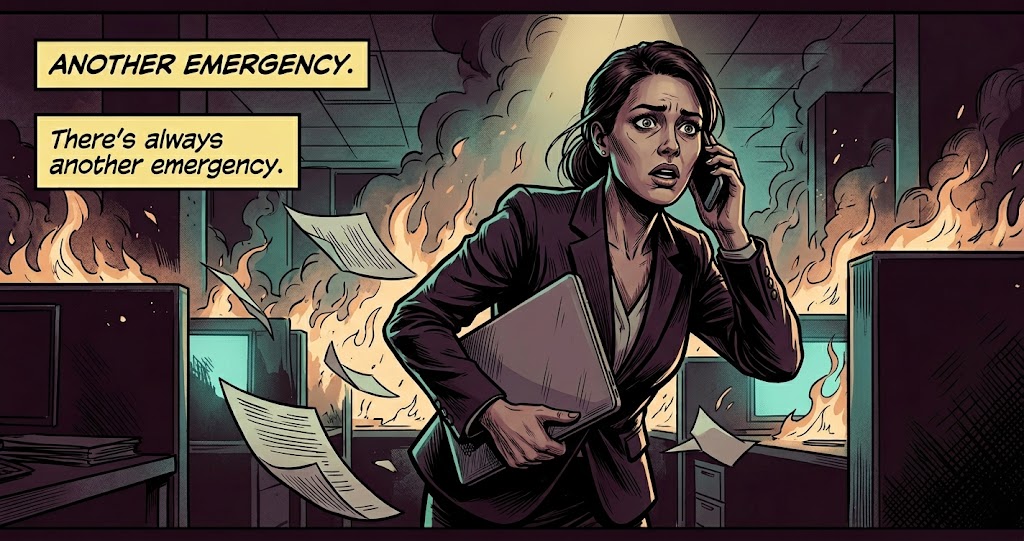
If you’re a Firefighter, you know the feeling. The day starts with a plan and ends with everything having changed. New campaign idea. New channel everyone’s talking about. Last week’s numbers looked soft, so you pulled the budget. Something shiny appeared in your inbox, and now the team is pivoting again. The motion is constant. The results are elusive.
Here’s the thing nobody tells the Firefighter: while you’re sprinting between fires, your existing customers are noticing. They’re noticing that the email cadence is erratic. They’re noticing that the loyalty program you launched six months ago has gone quiet. They’re noticing that the SMS messages feel scattered, disconnected from each other, like they’re coming from three different companies.
Firefighter businesses are often surprisingly good at acquisition. The energy, the hustle, the willingness to try new things — those traits attract customers. Keeping them is a different problem entirely, and it requires the opposite of what comes naturally to a Firefighter. It requires consistency, patience, and a plan you actually stick to.
“The Firefighter rarely has a slow day. They also rarely have a quarter where retention compounds. Those two facts are not a coincidence.”
What the Firefighter’s Retention Problem Actually Looks Like
The symptoms show up in predictable ways once you know what to look for. Your email open rates are inconsistent — high when you send something, but the gaps between sends are long enough that subscribers have forgotten who you are. Your SMS list exists but operates on vibes rather than a calendar. When you send a message, unsubscribes tick up because the message feels out of nowhere.
Your loyalty program, if you have one, was launched with excitement and has since drifted. Points accumulate and never get redeemed. Members don’t feel like members. The program is technically active and functionally invisible.
Your repeat purchase rate is lower than it should be for a business with a good product and satisfied customers. If you surveyed your churned customers, most of them wouldn’t say they left because they were unhappy. They’d say they just forgot about you. You stopped showing up. You stopped being present in their inbox, their phone, their mind. Firefighters create a brand experience that feels exciting during acquisition and fades after the sale.
Bain & Company research has found that increasing customer retention rates by just 5% can increase profits by anywhere from 25% to 95%. That’s not a retention problem. That’s a growth strategy — if you can sustain the consistency to execute it.
Why Retention Is Hard for the Firefighter Archetype
Retention marketing is inherently unsexy. It’s scheduled. It’s systematic. It requires that you build a flow, test it, leave it alone, and let it run. That’s the opposite of how the Firefighter brain operates. The Firefighter is energized by launching things, not maintaining them. By building new things, not nurturing existing ones.
Email automation feels like it’s not doing anything, so it gets turned off. The loyalty program dashboard doesn’t get checked because nothing seems to be happening. SMS campaigns don’t get sent because you’re not sure what to say and there are more pressing things on the list. And slowly, systematically, your customer base leaks — not because your product failed them, but because your marketing stopped showing up.
The core issue isn’t laziness or carelessness. It’s that the Firefighter has no operating structure for retention. There’s no calendar. There’s no owner. There’s no framework for what good looks like. Everything lives in someone’s head or in a document nobody’s looked at since Q1.
Building a Retention System a Firefighter Can Actually Stick To
Start With the Emails That Never Change
The most important retention emails are the ones that run automatically — welcome sequences, post-purchase follow-ups, win-back campaigns, milestone emails. These are not reactive. They’re built once, and they run. For a Firefighter, this is the single highest-leverage retention investment available: building automations that don’t require your attention every week.
A well-built welcome sequence introduces the customer to your brand over 5 to 7 emails, sets expectations, delivers value, and moves them toward a second purchase. A post-purchase flow reinforces the buying decision, reduces buyer’s remorse, surfaces complementary products, and asks for a review. A win-back sequence identifies customers who haven’t bought in 60, 90, or 120 days and gives them a reason to come back. None of these require you to show up every Tuesday and create something from scratch. Build them once. Let them work.
Create a Retention Calendar That Doesn’t Require Heroics
The Firefighter’s retention calendar typically has two settings: nothing and a burst. A sustainable retention calendar has a rhythm. Two to four emails per month. One SMS per week, maximum two. A loyalty program touchpoint tied to the same schedule. None of this requires a dedicated retention team. It requires a template, a calendar, and someone designated to own it.
The calendar doesn’t need to be creative every time. A monthly roundup. A product highlight. A behind-the-scenes email. A customer story. A loyalty reminder. These are repeatable formats that can be executed in under two hours once the template exists. The Firefighter spends more time in one strategy meeting than it would take to execute a full month of retention content — the problem isn’t time, it’s structure.
Use SMS for Retention, Not Just Promotions
Most Firefighter businesses that have an SMS list use it exclusively for sales and promotions. That’s a mistake. Promotional SMS messages are one-dimensional — they train your subscribers to expect a discount and nothing else. When you can’t offer a discount, you don’t send anything. The list goes cold.
Retention-focused SMS is different. It’s a drip of value between transactions. An early-access announcement. A product tip. A loyalty point update. A personalized reorder reminder. A ‘we haven’t seen you in a while’ message with something genuinely compelling. These messages build a relationship instead of just executing transactions, and they perform significantly better when the list is warm from consistent engagement rather than dormant and resentful of promotional blasts.
Make Your Loyalty Program Do Something Visible
If your loyalty program is invisible to your customers, it is not working as a retention tool — it is a liability that creates the illusion of a retention strategy without the substance. A loyalty program that customers forget they’re in is worse than no loyalty program at all, because it consumes budget and generates no behavioral change.
Visibility is a design choice. Your loyalty program should surface in your post-purchase emails. It should appear in your monthly communication. It should be mentioned in your SMS sequence. Customers should know their point balance. They should be told when they’re close to a reward. They should be reminded when points are about to expire. None of this is complex — it’s a matter of making sure your program is woven into your retention communications rather than sitting in a separate silo that nobody talks about.
The One Metric That Matters Most for the Firefighter
Repeat purchase rate. Not open rate. Not click rate. Not subscriber count. The metric that tells you whether your retention is working is whether customers are coming back to buy again.
If your repeat purchase rate is below 25% for a transactional business, or below 40% for a subscription or service business, your retention is broken. The exact threshold varies by industry and model, but the direction is clear: if the vast majority of your customers only ever buy from you once, you have a retention problem that no amount of new acquisition spend will fix.
Measure it monthly. Track it against a 90-day benchmark so you can see whether systematic changes are working. Give it time — retention improvements don’t show up in 30 days. Give them 90 days before evaluating whether a change worked or not.
“The Firefighter doesn’t need to become a different kind of business owner. They need to build the systems that work while they’re fighting other fires.”
What Changes When You Fix This
When a Firefighter gets their retention infrastructure in place — the automations running, the calendar filled, the SMS strategy consistent, the loyalty program visible — something interesting happens. The acquisition math changes. Every customer you bring in is worth more over time because you’re keeping them longer. CAC (customer acquisition cost) stays the same, but LTV (lifetime value) goes up, which means your entire business model becomes more profitable without changing what you’re spending on ads.
Customers who feel retained — who hear from you consistently, who feel like members rather than transactions, who get genuine value from your communications — are also your best source of word-of-mouth and referrals. Retention and acquisition stop being in competition. The retained customer becomes the acquisition channel.
This is the compounding effect that the Firefighter never gets to experience because the structure was never in place long enough to see it happen.
Find Out If Retention Is Your Real Problem
The Firefighter archetype is one of eight patterns we’ve identified in businesses whose marketing isn’t working. Some Firefighters have a pure retention problem. Others have a retention problem layered on top of a strategy problem — and the retention fixes only work once the strategy is clear.
The fastest way to understand where your business actually sits is to take our free marketing diagnostic. It identifies your archetype in about five minutes and tells you specifically what’s driving your pattern and what it would take to change it.
→ Take the free marketing diagnostic → bigbrainstrategy.com/marketing-diagnostic
About the Author
Nada Djuric built her career at the intersection of strategy, storytelling, and systems — leading retention and lifecycle marketing for brands including Morningstar Inc., Follett, Kenneth Cole, Junk Food Clothing, Grunt Style, Nogin, and U.S. Cellular. She has grown email databases from 150,000 to more than 4 million subscribers, built SMS programs from zero to 2 million opt-ins, and doubled email’s contribution to total company revenue from 15% to 30%. Her segmentation strategies increased customer lifetime value by 25%, improved repeat purchase rates by 15%, and lifted overall retention by 28%. Automated winback campaigns drove ecommerce retention up 32% and app retention by 60%. These results were not campaign spikes. They were engineered systems.
A former small business owner and adjunct English professor, Nada brings operational clarity and strategic precision to every engagement. Today she helps businesses design retention architecture that transforms customer data into predictable revenue growth.
Big Brain Strategy | The brains behind your growth. | bigbrainstrategy.com
Leave a Reply