
The Business That’s Always Busy But Never Ahead
The pipeline looks healthy. New customers are coming in. The sales team is hitting numbers. The marketing is producing leads. From the outside, the business looks like it is growing. From the inside, something feels off. Revenue is not climbing the way the acquisition numbers suggest it should. The team is working hard and the business is staying flat.
The reason is usually somewhere nobody is looking. Out the back door.
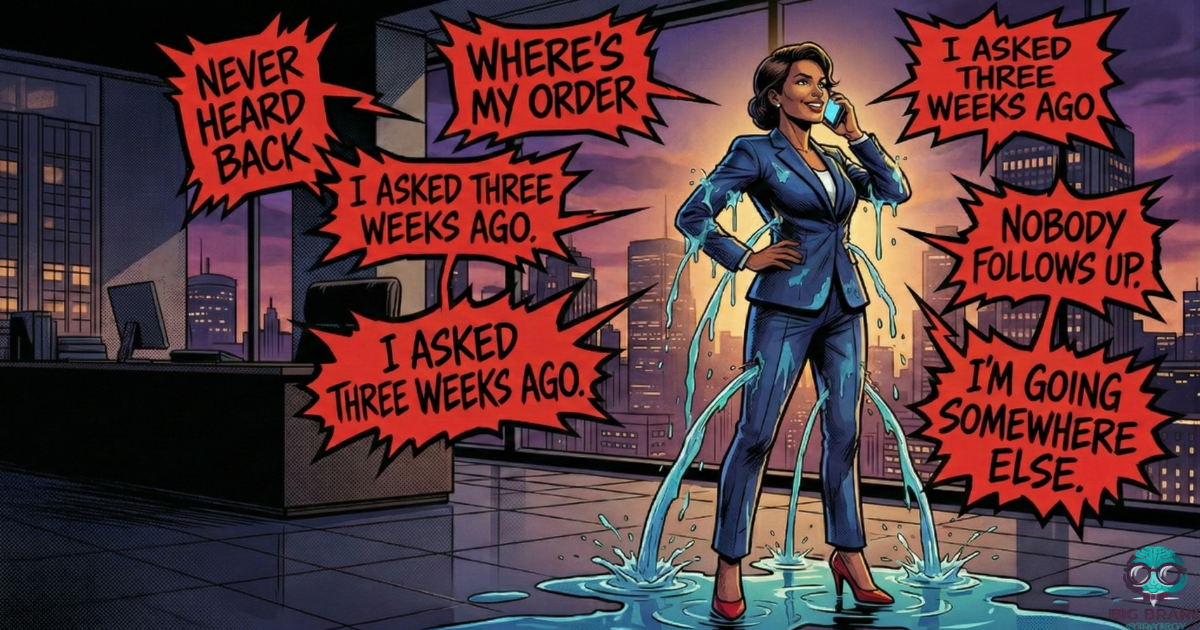
Customers are coming in the front and leaving out the back just as fast. Not loudly. Not with complaints in most cases. Just quietly, at renewal time or at the end of a project, deciding not to come back. And because the acquisition machine is running well enough to keep the top-line number stable, nobody is treating the exits as a real problem.
This is the Leaky Bucket. It is one of eight marketing archetypes we have identified in businesses that are stuck, and it is one of the most expensive patterns to be in because the cost of the problem is almost entirely hidden. The business sees what it is spending on acquisition. It almost never sees what it is losing to churn.
Customers are coming in the front and leaving out the back just as fast. The business sees what it spends on acquisition. It almost never sees what it loses to churn.
Why Retention Gets Ignored
Acquisition is visible. There are campaigns to run, leads to count, conversion rates to report, and a clear line of sight between spending money and getting customers. It feels like growth because it looks like growth. New logos on the website. New names in the CRM. Numbers going up.
Retention is invisible until it is not. A customer who renews does not generate a report. A customer who quietly does not renew often does not either, at least not one that gets anyone’s attention until the pattern has been running long enough to show up in the revenue numbers. By that point the business has usually been losing ground for months without realizing it.
There is also the psychology of it. Acquisition feels like offense. It feels like going out and getting something. Retention feels like maintenance. Businesses that are growth-focused, which is most of the businesses we work with, naturally spend more attention on the thing that feels like momentum. The problem is that momentum built on a leaky bucket is not real momentum. It is just expensive motion.
Harvard Business Review has documented that acquiring a new customer costs anywhere from five to twenty-five times more than retaining an existing one. The full piece is at hbr.org. When a business is chasing new customers to replace the ones that are quietly leaving, it is running on one of the most expensive treadmills in business. It takes enormous acquisition spend just to stay even.
What the Leaky Bucket Actually Looks Like
The Leaky Bucket business is usually genuinely good at sales and marketing. That is not the problem. The problem is that the same attention and investment that goes into getting customers never makes it to the experience those customers have after they sign.
Acquisition is the priority. Everything else is an afterthought.
The marketing budget goes to campaigns, ads, and lead generation. The sales team is measured on closed deals. The onboarding process was built quickly and never properly revisited. Customer support is underfunded and understaffed. The customer success function, if it exists at all, is reactive rather than proactive. The business put all of its strategic energy into getting customers and assumed the rest would take care of itself. It does not.
The product or service experience has not kept up.
The offer that won customers two years ago was competitive then. The market has moved. Competitors have improved. Customer expectations have shifted. But the core experience the business delivers has not evolved at the same pace. Customers who were satisfied at the start of the relationship find themselves underwhelmed by renewal time, not because anything went catastrophically wrong, but because the bar moved and the business did not move with it.
Nobody is talking to churned customers.
The most valuable information a Leaky Bucket business could have is sitting in the minds of the people who decided not to come back. Almost none of them are being asked why. There is no exit conversation, no offboarding survey, no structured attempt to understand what the experience was actually like. The business keeps optimizing acquisition while the real story is in the exits, and nobody is reading it.
The churn is masked by new volume.
This is what makes the Leaky Bucket so dangerous. As long as acquisition is running well enough to replace what is leaving, the revenue number stays stable and the problem stays invisible. The business is working twice as hard as it needs to just to stay in place, but the dashboard does not show that. What it shows is activity. Activity and health are not the same thing.
The business is working twice as hard as it needs to just to stay in place. Activity and health are not the same thing.
The Real Cost of High Churn
The direct cost is the acquisition spend required to replace every customer who leaves. But that is only part of it. The full cost runs deeper and in more directions than most Leaky Bucket businesses realize.
Lost lifetime value is the most significant number almost nobody is calculating. A customer who stays for five years and buys repeatedly is worth a completely different amount than a customer who churns after one transaction. When churn is high, the average customer lifetime value collapses, and the business needs an acquisition machine running at full capacity indefinitely just to maintain current revenue. There is no compounding. There is no base to build on. Just an endless cycle of replacing what should have stayed.
Research by Bain and Company, cited extensively including by Upland Software, found that even a 5% increase in customer retention can produce profit increases ranging from 25% to 95%. The reason the range is so wide is that it varies significantly by industry, but the direction is consistent across every category studied. More at uplandsoftware.com. That is the scale of what is sitting on the table in a Leaky Bucket business. Not a marginal improvement. A structural one.
There is also the referral cost. Happy long-term customers refer. Churned customers do not. A business with high churn is not just losing the revenue from the customers who leave. It is losing the pipeline that those customers would have generated through word of mouth. The growth engine that referrals provide never develops because the relationships do not last long enough.
The probability of selling to an existing customer is 60 to 70 percent. The probability of selling to a new prospect is 5 to 20 percent. That data, documented by Invesp among others, is at invespcro.com. A Leaky Bucket business is perpetually fishing in the expensive pond when it has a much cheaper and more productive one sitting right behind it.
Why Leaky Bucket Businesses Do Not Fix It
The fix seems obvious from the outside. Improve the experience. Build retention programs. Talk to customers who leave. Invest in the post-sale relationship the same way you invest in the pre-sale one.
Inside the business, it is more complicated. The acquisition team has metrics, budget, and visibility. They can show their work. Retention is harder to measure, harder to attribute, and harder to sell to leadership as an investment. When budget conversations happen, the team that can show leads generated and deals closed has an easier time than the team arguing that fixing the onboarding process will reduce churn by a meaningful percentage over the next year.
There is also the operational reality. Fixing retention usually means fixing something about the actual customer experience, and that often means admitting that the experience has not been good enough. That is an uncomfortable conversation for businesses that have been selling on the basis of how good they are. It is much easier to keep running more acquisition campaigns than to sit with the honest version of what the data is showing about why people are not staying.
What Actually Fixes a Leaky Bucket
The businesses that solve the Leaky Bucket problem do not do it by finding a better acquisition channel. They do it by building a retention infrastructure that gets as much attention as the acquisition machine already does.
Find the leak before you fix it.
The first step is understanding where customers are actually leaving and why. That requires data the Leaky Bucket business usually does not have in a useful form. When are customers churning? After the first transaction? At renewal? After a specific product or service experience? The answer determines where to focus. A business that does not know where the leak is cannot fix it. It can only pour more water in the top and hope for the best.
Build an exit conversation into the process.
Every customer who does not return should be heard from. Not a generic survey with a low response rate. A real conversation, or a structured attempt at one, that tries to understand what the experience was actually like and why they made the decision they made. This information is more valuable than almost any market research a business could commission, and most Leaky Bucket businesses are leaving it completely uncollected.
Invest in the post-sale experience with the same seriousness as the pre-sale experience.
The onboarding process, the customer success touchpoints, the quality of ongoing service delivery, these are not administrative functions. They are retention functions. Every dollar spent making the post-sale experience better has a higher return than most acquisition spending, because it compounds over the lifetime of the customer relationship rather than resetting with every new campaign.
Measure customer lifetime value alongside acquisition metrics.
A business that only measures what it spends to acquire customers and not what those customers are worth over time is making decisions with half the information it needs. When lifetime value sits next to acquisition cost in the same conversation, the math for investing in retention becomes much clearer. The business stops seeing retention as a cost center and starts seeing it as the thing that makes the acquisition investment worthwhile.
Where the Leaky Bucket Fits in the Bigger Picture
The Leaky Bucket is one of eight marketing archetypes we have identified in businesses that are stuck. Each one describes a different way growth breaks down, with a different root cause and a different fix. The Leaky Bucket is the one where the growth engine is actually working, which is what makes it so hard to diagnose. Everything looks fine until you start asking what percentage of last year’s customers are still customers today.
The business does not need more acquisition. It needs a reason for the customers it already has to stay. That is a different problem and it requires a different solution. Throwing more budget at lead generation while retention stays broken is the most expensive way to run in place that we have ever seen.
If you are not sure whether your business has a retention problem, the free marketing diagnostic at bigbrainstrategy.com/marketing-diagnostic takes about five minutes and will tell you which of the eight patterns your business is actually in. If you want the full overview of all eight archetypes and what each one requires, that is at bigbrainstrategy.com/marketing-problems-are-patterns.
The bucket is only as useful as it is watertight. Find the leak.
About the Author
Mike Birt is Co-Founder and Lead Strategist at Big Brain Strategy, a marketing strategy consultancy that helps businesses grow through acquisition, conversion, and retention. He has spent two decades building marketing departments, scaling brands, and telling people things they sometimes didn’t want to hear about why their marketing wasn’t working.
Big Brain Strategy | The brains behind your growth. | bigbrainstrategy.com
Leave a Reply