
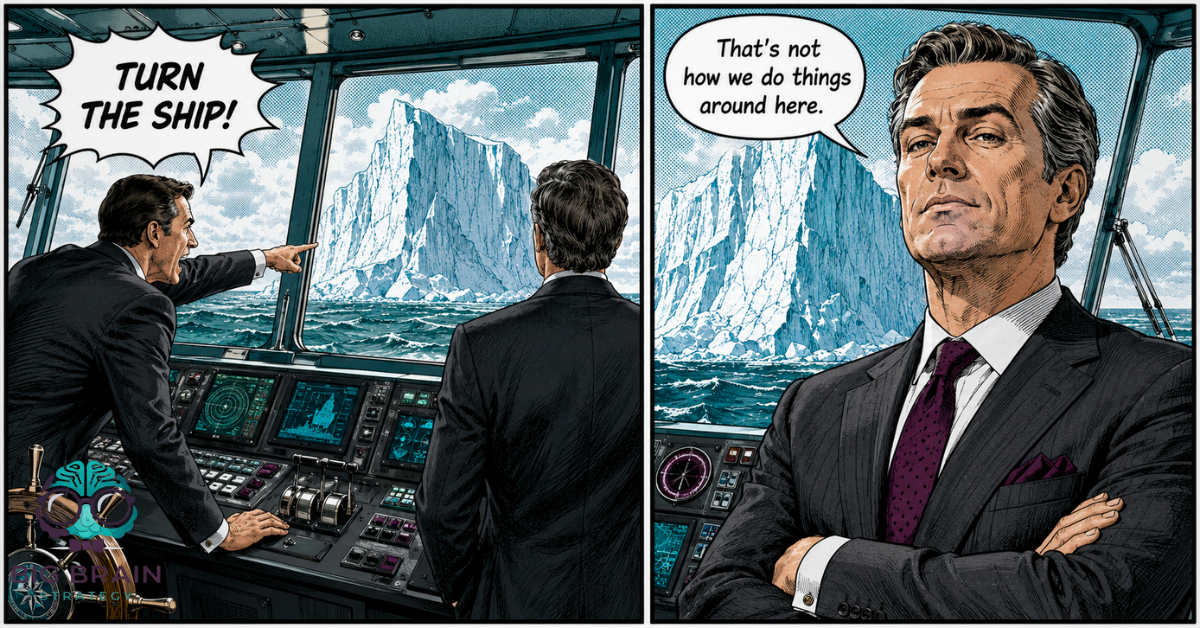
When Things Stop Working: The Trap of Active Inertia
Growth stalls. Leads dry up. The channel that used to fill the pipeline stops filling it. And almost every business responds to that moment the same way: work the old playbook harder.
More cold calls. A bigger ad budget. Longer hours on the tactics that used to work. It feels like discipline, like responsibility. In reality, it’s the fastest way to make sure nobody ever finds the real problem.
What Is Active Inertia?
Active inertia is a business’s tendency to respond to a changing market by working harder at the exact strategies that used to succeed, instead of adapting to what the market now requires. The term comes from Donald Sull’s 1999 Harvard Business Review article (Sull, 1999), and it explains why the companies most confident in their systems are often the slowest to notice those systems have stopped working.
Nothing here is standing still. It’s sprinting in the wrong direction, and sprinting faster only carries you further from where you needed to go.
What Causes Active Inertia?
Nobody sits down and decides to run their company into a wall. Active inertia sneaks in through three forces that are hard to see from inside the organization.
Rearview mirror management. Financial leaders manage risk with historical data because historical data is what they have. It’s real, it’s measurable, and it’s comforting. The problem is that past performance describes a market that may no longer exist. A CFO who greenlights budget based on what worked two years ago isn’t being careless. He’s using the only tool he trusts, in a situation where that tool no longer applies.
The fear of the unproven. New ideas come with risk, and risk creates anxiety in a room full of people whose jobs depend on being right. So the safer feeling move is to do the wrong thing harder rather than try the right thing and possibly fail in public. This is the same instinct behind what researchers call the competence trap: mature organizations lean on familiar routines because those routines produce predictable short-term returns, and that predictability quietly starves the exploration that would have found the next thing (March, 1991).
Institutional bias. “That’s how we’ve always done it” isn’t a strategy. It’s an immune response. Teams that have been inside a system for years develop blind spots to exactly where that system is breaking, because the people closest to a process are usually the last ones to see it stop working. Organizational researchers have documented this for decades: established companies build rigid processes and legacy commitments that actively resist the kind of fundamental change a shifting market demands (Hannan & Freeman, 1984).
Put those three forces together and you get a company that isn’t failing to notice the problem. The organization has built itself to avoid acting on it.
The Innovator’s Dilemma Isn’t Just for Tech Companies
Clayton Christensen wrote about this pattern in the context of technology disruption, but the mechanism isn’t unique to tech. Well-managed companies fail not because their leaders are lazy or foolish. They fail because their own financial planning tools, risk metrics, and existing customer demands all point toward the safe, proven, short-term bet, and away from the unproven idea that doesn’t pay off for a year or two (Christensen, 1997).
A dental group that’s been referral-driven for fifteen years isn’t ignoring digital marketing because nobody told them about it. They’re ignoring it because every internal signal, from the CFO’s spreadsheet to the front desk staff’s daily routine, rewards doing what already works and punishes anything that doesn’t show a return by next quarter.
That’s not a people problem. It’s a structural one, and working harder inside the same structure won’t solve it.
Why This Requires Someone From Outside
Here’s the part that’s hard to hear: the team that built the current system is rarely the team that can see where it’s broken. Ask them to fix a problem their own legacy logic created, and what usually comes back is an old solution wearing new language. Same tactics, new deck.
Real change tends to require an outside perspective. Not because outsiders are smarter, but because they’re not carrying the same history. They didn’t approve last year’s budget. Defending old decisions isn’t their job. They can look at the whole system and ask an obvious question nobody inside has asked in years: why are we still doing it this way?
The graveyard of business is full of companies that kept optimizing an idea long after the idea stopped working. Not because they were careless. Because optimizing what you already know how to do will always feel more responsible than admitting the playbook is the problem.
The NFL Runs This Play Every Year
Look at the NFL. When a franchise underperforms for two or three seasons straight, the fix is never more effort from the same coaching staff. Ownership fires the head coach, and most of his coordinators leave with him. A new coach walks in with a new staff, people who never sat in a single one of the old meetings.
Franchises tend to swing the other direction on coaching philosophy too. Fire an offense-minded head coach, and the next hire usually comes from the defensive side. The reverse happens too: fire a defense-first coach, and the next one runs the offense. Teams aren’t just changing who calls the plays. They’re deliberately changing how the organization thinks, because more of the same thinking got them here in the first place.
Struggling businesses run the same play, they just rarely explain why out loud. If the people already in the room could have fixed the problem, they would have fixed it by now. Something is stopping them. Sometimes the change needed feels too risky to the people who’d have to make it. Other times the idea never even occurs to them. They’re too deep inside a playbook they’ve repeated for years to see that another option exists.
How Do You Fix Active Inertia?
Fixing active inertia starts with questioning the instinct to work harder before questioning the strategy itself. Three things tend to actually move a stalled business forward.
Bring in a perspective that last year’s budget decisions didn’t shape. Someone who didn’t approve the current plan can see it more clearly than someone defending it. Ask what the current strategy is protecting, not just what it’s producing. A tactic can look busy and still be propping up a system that stopped matching the market years ago. And size the real gap between where the business is and where the market has moved, instead of assuming more effort closes it. Effort was never the problem. Direction was.
If growth has stalled and the instinct in the room is to push the current strategy harder, that instinct is worth questioning before anyone acts on it. The data that got you here won’t tell you what to do next. Their own team won’t always see where the system is breaking. And the fear of trying something new will keep pointing everyone back toward the thing that already isn’t working.
Reach out to our team and we’ll help you find exactly where the old playbook stopped matching the market, and what to build instead.
About the Author
Mike Birt is Co-Founder and Lead Strategist at Big Brain Strategy, a marketing consultancy that helps businesses grow through acquisition, conversion, and retention.
Leave a Reply