
Fiverr ran a Facebook ad recently. It showed a horse and buggy on a modern highway, surrounded by cars. The caption read: “This is how businesses without AI look in 2026.”
I understand what they were going for. Fear is a reliable motivator and the image is memorable. But the argument underneath it is wrong, and I think it’s worth taking apart because a lot of businesses are making expensive decisions based on exactly this kind of thinking.
The premise is that AI gives you an edge. Businesses using AI are the cars in this metaphor. Those without it are the horse and buggy, and adopting AI tools puts you ahead of your competition.
None of that is true. And believing it is costing businesses real money.
When Everyone Has the Same Tool, Nobody Has an Advantage
Access to AI is not differentiation.
Think about what it means for something to be a competitive advantage. A real advantage is something your competitors can’t easily replicate: a proprietary process, a relationship that took years to build, deep expertise in a specific market. Something that gives you an edge because not everyone can have it.
AI is not that. ChatGPT, Claude, Gemini, and every other major AI tool available today are subscription products. Anyone can sign up. Your most direct competitor signed up the same week you did, probably. The highest ChatGPT subscription tier costs $200 a month. That is not a moat. Any business with a credit card can match it by tomorrow morning.
Fast Company put it plainly in a March 2026 piece on AI: AI doesn’t create an advantage on its own. It amplifies the judgment that already exists within an organization, for better or worse. Good judgment plus AI means you move faster. Poor judgment plus AI means you produce more of the wrong thing, faster and at greater volume.
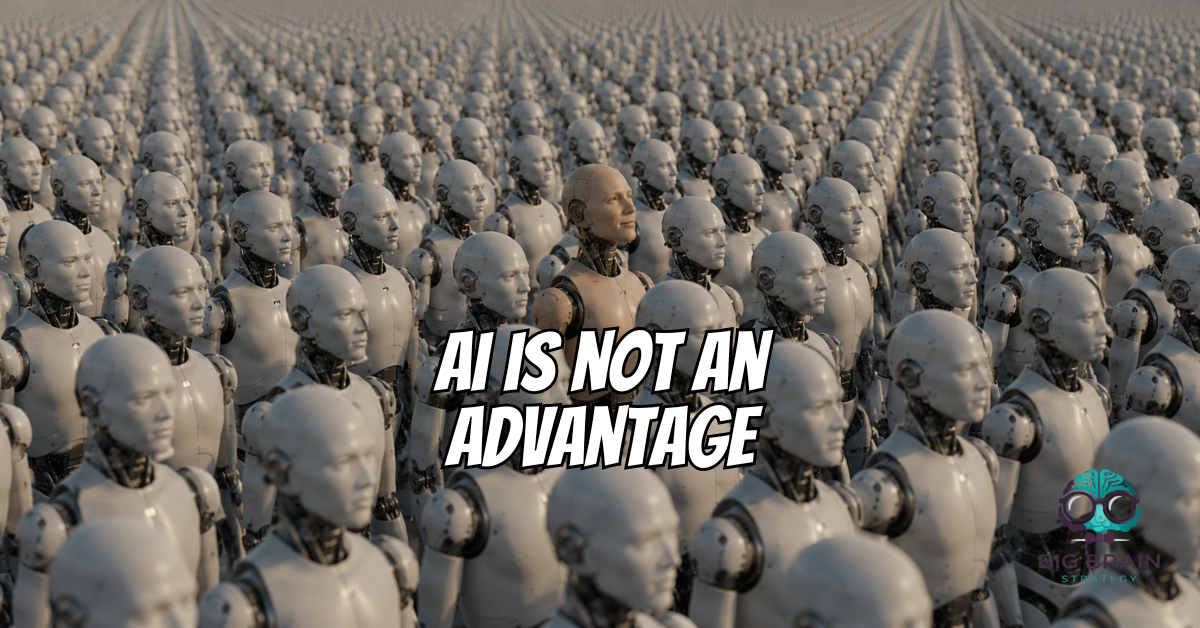
So no, you do not have a leg up on your competition because you have an AI subscription. Your competition has the same subscription. The question is what each of you is doing with it.
AI Has Created a Sea of Sameness
More content everywhere. Less reason to pay attention to any of it.

A recent Fiverr Facebook ad. The horse and buggy is meant to be you, if you’re not using AI.
Here is what AI actually did to the content landscape: it made production nearly free. Blog posts, social media captions, website copy, landing pages, email sequences, ad creative, entire brand identities. Things that used to require real time and real skill now take seconds. The barrier to producing content collapsed entirely.
What happened next was predictable. Everyone started producing more. A lot more. And because they’re all using the same tools with the same training data and the same defaults, most of it sounds the same. Read enough AI-generated blog posts and a pattern emerges: the same sentence structures, the same transitional phrases, the same tendency to sound authoritative while saying nothing specific. The same voice, endlessly replicated across millions of pages.
Consumer data backs this up. Research from Billion Dollar Boy, cited in a 2026 trends report, found that consumer preference for AI-generated content has dropped to 26%, down from 60% just three years ago. Audiences got more content and started trusting it less. That is the direct result of a world where everyone adopted the same tools and produced the same output.
The Fiverr ad frames AI adoption as the difference between the horse and buggy and the car. A more accurate metaphor: AI is the highway. Everyone is on it. The question is whether your car has anything worth driving to.
The Actual Problem With How Businesses Are Using AI
The tool isn’t the problem. How most businesses apply it is.
Nothing is inherently wrong with using AI. The problem is what most businesses are using it for: replacing the human judgment, voice, and specificity that made their content worth reading in the first place.
A business that uses AI to draft a first version, then edits it into something specific and human, is using AI well. Taking the raw AI output, hitting publish, and calling it a content strategy just adds another voice to the noise. And that noise has real consequences.
Google updated its quality guidelines to reward what it calls E-E-A-T: experience, expertise, authoritativeness, and trustworthiness. The added E, experience, is specifically a counterweight to AI-generated content. Algorithms now look for signals that a real person with real knowledge actually wrote something. Generic AI output doesn’t provide those signals. Over time, that means less visibility, not more.
On social media, the trust problem is even faster. We have watched brands lose audiences in real time when those audiences figured out they were talking to an AI, or reading content generated by one. The reaction is not mild disappointment. Customers feel deceived. Following a brand implies a relationship with a person or a team of people who actually care. AI breaks that assumption and the backlash tends to be loud.
So businesses that went all-in on AI for content creation didn’t just fail to gain an advantage. Some of them actively damaged their brand in the process.
What Actually Creates an Advantage Right Now
The things AI can’t produce are worth more than they’ve ever been.
Here’s the irony: because AI flooded the market with generic content, the things AI cannot produce have become more valuable. Specific expertise. A recognizable point of view. Content that could only exist because a real person with real experience created it. Authentic relationships with an audience built over time. These things were always valuable. Now they’re scarce in a way they weren’t before AI made everything else cheap.
Brand awareness is one of the clearest examples. We wrote about the Google and Tracksuit study showing that brand awareness drives share of search. The mechanism is simple: when people recognize your name, they click on you. When your name means something to them, they trust you. Trust compounds over time and AI cannot manufacture it. Spending years showing up consistently, saying specific things in a specific voice, building recognition with a specific audience creates something your competitors cannot replicate by upgrading their subscription tier.
This is also where the four gets of marketing matter. Get seen, get remembered, get trusted, get purchased. AI can help with the first one at scale, cheaply. The problem is that everyone else is getting seen at the same scale, for the same cheap price, with the same looking content. Getting remembered and getting trusted require something different: something specific and human.
The businesses pulling ahead right now are not the ones with the best AI stack. Most of them use AI for something: drafting, research, editing, workflow. But they haven’t confused access to a tool with a strategy. Their strategy is built on judgment, voice, and consistency. AI helps them execute faster. It doesn’t replace the thing that makes execution worth anything.
What to Do Instead
Use AI. Just don’t mistake it for a strategy.
Use AI to go faster, not to replace thinking. Draft with it. Research with it. Use it to clean up structure and catch errors. These are legitimate uses that save real time without sacrificing the specificity and voice that make your content worth reading.
Stop publishing AI output without meaningful human editing. The default AI voice is recognizable to anyone who has read enough of it. Your customers are reading enough of it. Editing it into something specific takes longer than hitting publish, but that time is the point. That time is where your content stops sounding like everyone else’s.
Invest in the things AI cannot do: your actual perspective, built from actual experience. Content that references specific situations, specific clients, specific results. A social presence driven by a real person showing up in a real way. These are your actual competitive advantages, and they compound in a way that a subscription to any AI tool never will.
The horse and buggy in Fiverr’s ad isn’t the business that doesn’t use AI. It’s the business that confused using AI with having a strategy, produced a flood of identical content, and wonders why none of it is working.
The Bottom Line
Every business has access to AI. That means AI access is the baseline, not the advantage. Businesses that understand this invest in the things no subscription can replicate: judgment, voice, consistency, and real relationships with real people.
For the businesses we work with, this is the conversation worth having right now. Not which AI tools to adopt, but what your actual competitive position looks like and how to build something durable on top of it.
Anyone can have AI. Not everyone knows what to do with it.
Not sure where your marketing is breaking down? Take the free diagnostic: bigbrainstrategy.com/marketing-diagnostic
About the Author
Mike Birt
Mike Birt is Co-Founder and Lead Strategist at Big Brain Strategy. He has spent his career building marketing systems for businesses from startup to scale, with a focus on connecting acquisition, conversion, and retention to actual revenue. He believes most marketing problems are strategy problems in disguise.
Big Brain Strategy | The brains behind your growth. | bigbrainstrategy.com
Leave a Reply