
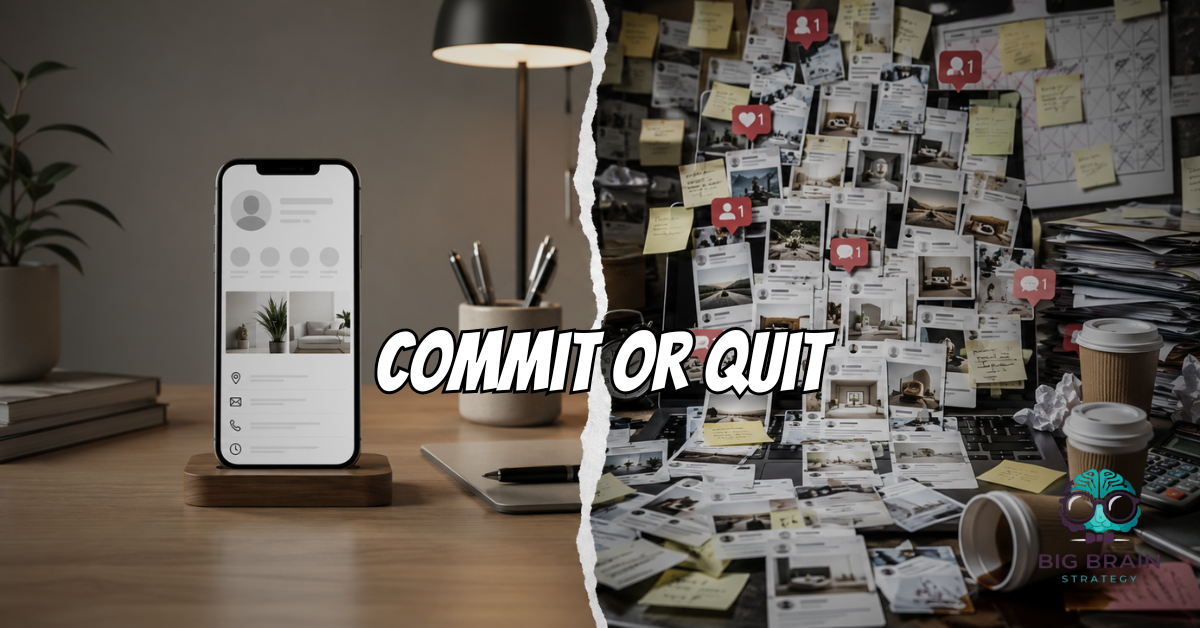
If you cannot post every day, quit organic social media, turn your profile into a business card, and put those hours somewhere they will actually do something. Three posts a week is the most expensive way to get nothing.
Nobody in my industry wants to say that, and saying it costs me nothing, because I am not selling you a content calendar.
Organic social media was already rigged
Reach for business pages has been shrinking for about a decade, and the platforms did that deliberately. They sell advertising. Free distribution to a company page is inventory they would rather charge you for. So every year they hand you a little less, and every year somebody sells a business owner a posting schedule and promises consistency will carry the account through.
The numbers stopped being arguable a while ago. Socialinsider studied 25 million posts from more than 130,000 business pages and found Facebook engagement sitting at 0.15 percent, with brands cutting their own posting volume 22 percent year over year. The people paid to believe in the channel are quietly backing away from it.
For a long stretch you could still win anyway. Outlast the companies that quit in month four, stay patient for a year or two, and something usually broke your way. Slow and difficult, but open.
Then the cost of producing a decent post went to zero.
Good enough became free
That is the change nobody has priced in yet. Making something competent used to take time or money, which is the only reason most of your competitors were bad at this. They could not keep it up. Today every business in your category generates an endless supply of posts that look fine and read fine and cost nothing, which is exactly why AI is not an advantage for anybody who thinks a content tool is a strategy.
Showing up regularly with reasonable content used to separate you from the field. Now it describes the field. Whatever slot you were winning by being consistent and moderately good, you are losing, and you are losing it to companies that barely tried.
Organic social media is a shotgun in the dark
Every social media strategy deck skips this part. With organic, you do not choose who sees your post. There is no targeting and no audience guarantee. You publish, an algorithm decides whether to show it to anyone, and you find out after the fact.
Paid works differently, because you can aim it. Organic is a shotgun blast into a crowd, and you are hoping some of it lands on somebody who might hire you. When aiming stops being an option, the only thing left under your control is how many times you pull the trigger.
Picture a radar screen
Every sweep of the arm is one day. Post, and you show up as a blip on your audience’s radar. Go quiet, and their radar keeps running without you. They are still scrolling. Nobody is holding a phone waiting for your thoughts on seasonal maintenance.
Now look at everything else lighting up that screen. Cat videos, stand-up clips, political fights, somebody’s relationship advice, a guy who spent nine years in prison telling stories about it. None of it competes with your business and all of it competes for the same space in your customer’s head, which is the entire reason brand awareness actually matters and why most businesses measure it wrong.
Four days of silence does not hold you steady. It buries you under everything that showed up while you sat it out.
When aiming stops being an option, the only thing left under your control is how many times you pull the trigger.
Daily is the price of entry
A whole cottage industry tells you the opposite right now. Post less often for more impact. Make fewer, higher quality pieces and let the work speak for itself. It sounds disciplined and mature and it gets how these platforms distribute content completely backwards.
Watch what audiences have started doing to polished content while you are at it. Slick edits and perfect production increasingly read as machine-made, and people scroll right past. Sprout Social’s 2026 pulse survey of more than 2,000 users found 40 percent of consumers now discover products through employee-generated content, rising to 61 percent among Gen Z. Real people beat polished brands, and the expensive video no longer buys what it used to.
Audiences will tell you they want real, unpolished, human content. They mean it. Every one of those people also consumes everything else on the platform without complaint, which is why authenticity only earns you tolerance rather than winning anything on its own.
A posting schedule is not a content strategy
Daily kills most businesses a different way. They commit on Monday, run dry by the second week, and start reaching for a sunrise photo with a quote about grinding. National Donut Day shows up next. After that comes a graphic about how the universe rewards the people who want it badly enough.
Nobody hires an accountant for their quotes.
Filler costs the same forty minutes as real work and returns nothing, because it says nothing about your customer’s problem. Personality still belongs in the mix. Showing who you are makes people comfortable hiring you. Filling a square on a calendar makes people scroll.
Nobody hires an accountant for their quotes.
The math follows straight from the shotgun problem. You do not choose which post a prospect sees, and plenty of them will only ever see one. Spend that single impression on a sunrise and a caption about grinding, and you told a stranger nothing about their problem and nothing about whether you could fix it. Your time and your budget both run out eventually. Burning either one on filler while the one prospect who mattered scrolled past costs more than the forty minutes.
My rule of thumb after twenty years of running social media for businesses: 80 percent of what you publish sits on your customer’s side of the table. What breaks in their business. How much the break costs them. Which questions they should ask before they hire anybody. Where most people in your category get it wrong. Your customer opens the app thinking about their own business, and they stop for the post that names something they already worry about.
Keep the other 20 percent for your face and your opinions. The story from the job site, the take nobody else in your category will say out loud, the reason you bother doing this at all. That content still works for the customer, because it answers whether they want to deal with you. Telling them it is always darkest before the dawn answers nothing.
Most businesses cannot do this, and that is fine
Daily means daily. Batch twelve posts in January and go silent through March and you have not done it. Neither has the company that panics into a posting spree every time revenue dips. Run a fifteen person accounting firm and the honest question becomes whether anybody there has forty spare minutes a day, every day, indefinitely. Usually nobody does, which is also why hiring a social media manager solves less than most owners expect when there is no strategy behind the hire.
Half-committing does not get you half the results. It gets you nothing, and it costs real hours you could have spent on something that compounds. Zero on purpose beats three a week by accident.
Half-committing does not get you half the results. It gets you nothing.
How to quit properly
A dead profile is worse than no profile. Most people who look you up on social already know your name, because they got a referral or saw your ad or met you at an event. They are checking whether you are real.
So make the profile pass that check and then leave it alone. Current logo, a description that says what you actually do, a working link, contact information. Five or six posts that hold up no matter when somebody reads them. A pinned post pointing where you want people to go. Somebody watching the inbox, because a message that sits for six days undoes everything above it.
Then take the time back and put it into email, referral relationships, or reviews. Plenty of businesses get more per hour out of those, and nobody throttles your email list to sell you ads.
Who should still play
Volume by itself saves nobody. Companies post seven days a week and get nothing for it, because anyone in their category could have produced the same posts. The Socialinsider benchmark data covers 70 million posts across four platforms and the pattern holds everywhere: more output does not rescue undifferentiated content.
What separates the businesses that win is access to something no competitor can show. The roofer who opens a ceiling and finds forty years of somebody’s terrible decisions has it. So does the prison guy. That accountant who will walk you through what actually happened to a real client during an audit has it too, assuming they will talk.
An AI can write a post about roofing. It cannot generate what you found in that ceiling.
So the real question has nothing to do with your camera or your posting schedule. Do you have something to say every day that your competitors cannot say, and will you put your face on it? Answer yes, commit, post daily, and stop worrying about production value. Our free social media copywriting guide covers how to turn that raw material into copy that sounds like a person wrote it. Answer no and the business card is the honest move.
The middle is where the time and the money go to die. Commit or quit. Pretending is the only wrong answer.
Not sure which one you are? Start with the free marketing diagnostic. It takes a few minutes and tells you where the actual problem sits. If social turns out to be a symptom of something further upstream, that is the kind of thing we work through in our strategy work with clients before anybody builds a content calendar.
About the Author
Mike Birt
Co-Founder and Lead Strategist, Big Brain Strategy
Mike Birt is Co-Founder and Lead Strategist at Big Brain Strategy. He has spent his career building marketing systems for businesses from startup to scale, with a focus on connecting acquisition, conversion, and retention to actual revenue. He believes most marketing problems are strategy problems in disguise.
Big Brain Strategy | The brains behind your growth. | bigbrainstrategy.com
Leave a Reply