
Your Team Is Busy. Your Customers Are Leaving. Nobody Noticed.
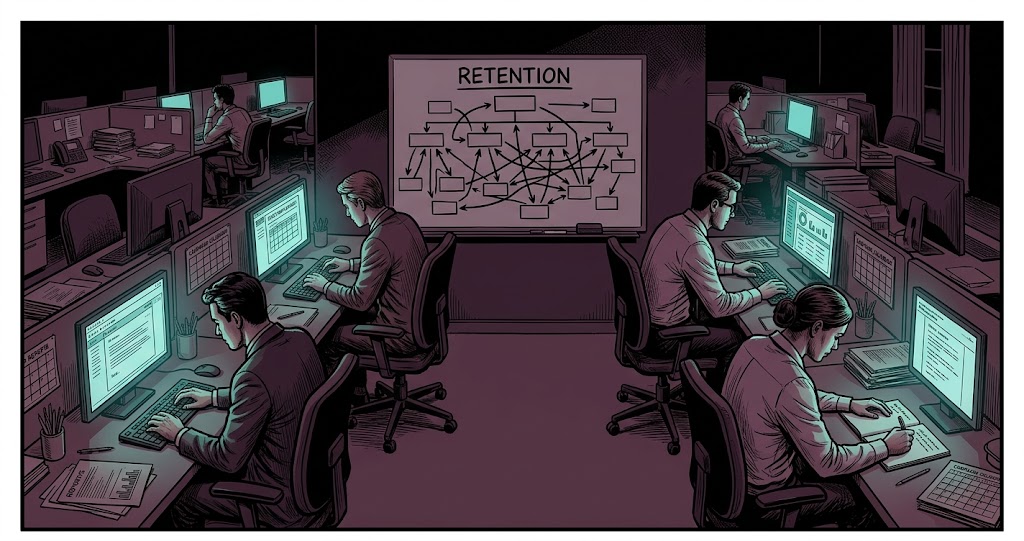
The Headless Horseman has a marketing team. Emails go out. Content gets posted. Campaigns run. The operation looks active from the outside and functions in slow chaos from the inside. Ask anyone on the team what the retention strategy is and you will get a different answer from every person in the room, if you get an answer at all.
Retention is the first casualty in organizations where strategy has been delegated without being defined. It is not that nobody cares about keeping customers. It is that nobody owns it. Email might live with one person. SMS with another. The loyalty program might technically belong to a vendor who sends a quarterly report that nobody reads. The customer experience after the sale is a patchwork of whoever happened to be responsible that week, which means it is inconsistent, uncoordinated, and frequently invisible to the leadership team trying to understand why the revenue numbers are not adding up.
The Headless Horseman’s retention problem is not effort. It is architecture. Nobody built the system, assigned the owner, defined the goal, or connected the tactics to the outcome.
Retention in a Headless Horseman organization is everyone’s responsibility and nobody’s job. That distinction is why it fails.
The Hidden Retention Cost of Organizational Chaos
When retention is not owned, the customer experience after the sale becomes entirely dependent on whoever happens to touch each communication. The welcome email reflects one person’s voice and priorities. The follow-up SMS sounds like a different brand. The loyalty program email uses a template nobody has updated in eighteen months. The win-back campaign, if one exists, was built by someone who left the company and is now running on autopilot with nobody checking whether it is working.
Customers experience all of this as incoherence. And incoherence is expensive.
McKinsey research on experience-led growth found that inconsistent customer experiences are among the top drivers of churn. Not bad products. Not pricing. The feeling that a brand does not have its act together. The Headless Horseman creates that feeling at scale, across every customer touchpoint, because the act is genuinely not together.
The financial consequence is real. A customer who has a coherent, consistent post-purchase experience is significantly more likely to buy again. A customer who receives disconnected, inconsistent communications after the sale is being trained, slowly and invisibly, to treat the brand as a one-time transaction rather than an ongoing relationship.
What a Retention Architecture Looks Like for the Headless Horseman
Step One: Assign One Owner
Before building any retention tactic, the Headless Horseman organization needs to answer a single question: who is accountable for repeat purchase rate? Not for email. Not for SMS. Not for the loyalty program. For repeat purchase rate, the outcome that all of those channels are supposed to drive.
That person does not need to execute everything. They need to own the outcome. They set the strategy. They define what good looks like. They hold the channels accountable. They bring the data to leadership. Without this person, every retention effort will continue to exist in its own silo, optimized for its own metrics, and disconnected from the revenue outcome it is supposed to produce.
Step Two: Build a Retention Brief
The Headless Horseman’s biggest retention problem is the absence of a shared document that defines what the retention strategy actually is. Not a 50-page strategy deck. A one-page brief that answers five questions: Who is the customer we are trying to retain? What does success look like in 90 days, measured how? Which channels are we using and what role does each one play? What is the messaging framework that connects each touchpoint? What is the escalation path when a customer shows signs of churning?
Every person who touches retention communications, email copywriter, SMS manager, loyalty program coordinator, customer success team, should be able to read this brief and understand exactly where they fit. If they cannot, the brief is not clear enough. If the brief does not exist, everything downstream will reflect that absence.
Step Three: Align the Channels Into a Single Journey
Email, SMS, and loyalty are not separate retention programs. They are three channels delivering one customer experience. In a Headless Horseman organization, they are typically operated by different people with different calendars and different definitions of success. The customer receives all three and experiences the incoherence that results.
A unified retention journey maps every post-purchase touchpoint in sequence. The customer buys. The post-purchase email goes out within an hour. Three days later, an SMS confirms the delivery and surfaces a tip for using the product. Five days later, an email from the founder or brand voice builds relationship. Two weeks later, a loyalty points update tells the customer where they stand. Thirty days later, a cross-sell email introduces something relevant to their purchase. Sixty days later, if they have not bought again, the win-back sequence begins.
Every one of these touchpoints is coordinated. They reference each other. The SMS knows the email went out. The loyalty update reflects what the customer actually bought. The win-back sequence is triggered by behavior, not a calendar someone checks manually. This kind of coherence is not technically complex. It requires someone to own the design and execution of the whole journey, not just their individual piece of it.
Email Strategy for the Headless Horseman
In most Headless Horseman organizations, email is the most underdeveloped retention asset despite being the most powerful one. The team sends promotional emails. They may have a welcome sequence of some kind. Beyond that, the email program is reactive and inconsistent.
The highest-leverage email investment for the Headless Horseman is systematizing the lifecycle. Welcome sequences, post-purchase flows, milestone emails, and win-back campaigns are all automations, built once, run indefinitely, owned clearly. The Headless Horseman’s email problem is not content. It is automation architecture. Build the flows. Assign the owner. Define the triggers. Set a 90-day review cadence. The content can be simple. The system is what does the work.
SMS and Loyalty: Two Channels That Amplify Each Other
The most effective SMS use case for a Headless Horseman organization is not promotional. It is transactional and relational. Delivery confirmations. Loyalty point updates. Reorder reminders. Early-access alerts for loyal customers. These messages have open rates above 90% and generate response rates that email cannot match, precisely because they are expected, relevant, and brief.
Pair SMS with a loyalty program and the effect compounds. A customer who gets an SMS telling them they are 50 points away from their next reward has a reason to engage that is personal, specific, and actionable. That is not a blast. It is a conversation. And it is the kind of conversation that turns one-time buyers into repeat customers without requiring the team to manually manage every interaction.
The Metric That Will Tell You Retention Is Fixed
Cohort analysis is the clearest lens on whether retention has improved. Harvard Business Review has documented that the value of keeping the right customers compounds significantly over time. Look at customers who bought in January. What percentage bought again in February, March, April? Now compare that to customers who bought in January of last year. Is the curve improving?
Improving cohort retention curves mean the retention system is working. Flat or declining curves mean the fixes have not reached the customer yet. Run this analysis every quarter. The data lives in your commerce platform or CRM. It does not require a vendor to surface it. Bring it to the leadership team. Make it the primary measure of whether the retention owner is doing their job.
Where to Start
The Headless Horseman is one of the most common archetypes we work with and one of the most fixable, once the strategy architecture is in place. The team is already there. The channels already exist. What is missing is the owner, the brief, and the unified journey that ties everything together.
If this pattern sounds familiar, the free marketing diagnostic at bigbrainstrategy.com/marketing-diagnostic takes about five minutes and will tell you which of the eight patterns your business is actually in and what is driving it. The Headless Horseman’s retention problem is not a people problem. It is a structure problem. And structure can be fixed.
About the Author
Nada Djuric is Co-Founder and Lead Retention Strategist at Big Brain Strategy, a marketing consultancy focused on turning customer behavior into revenue. She has spent two decades building and scaling retention systems for brands including Morningstar Inc., Kenneth Cole, Junk Food Clothing, and U.S. Cellular, growing email audiences into the millions and driving retention channels to approximately 30% of total revenue. She specializes in segmentation, lifecycle strategy, and fixing the gaps most brands ignore, usually the ones quietly costing them money.
Big Brain Strategy | The brains behind your growth. | bigbrainstrategy.com
Leave a Reply