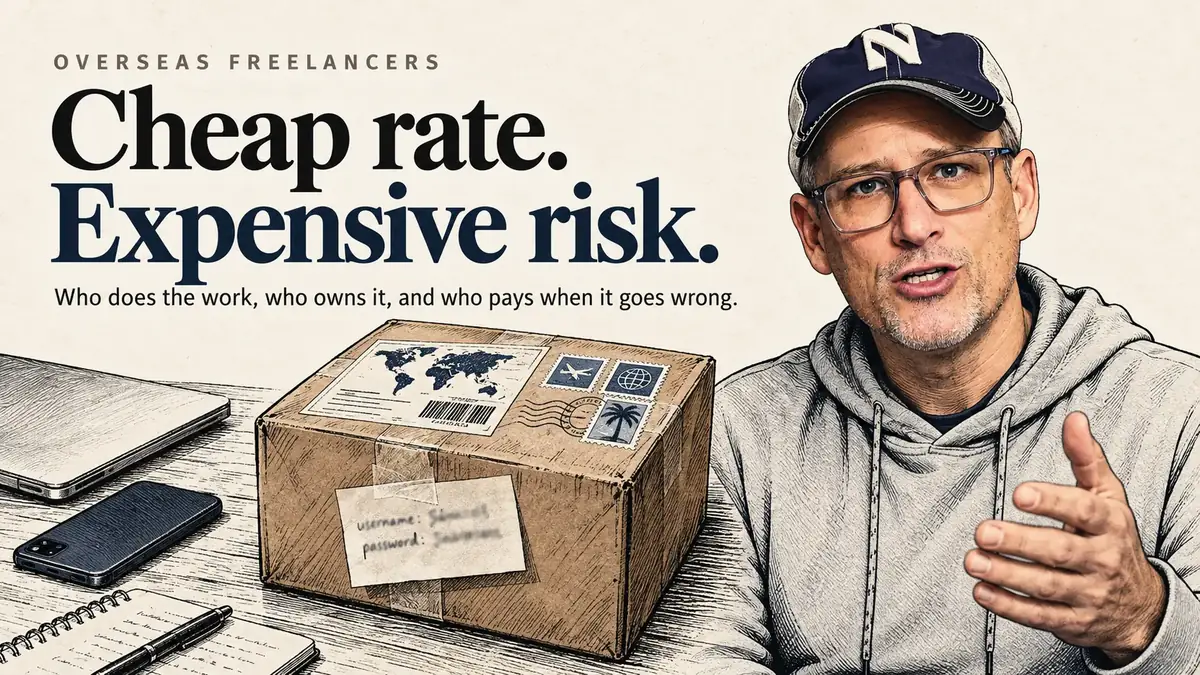
The crackdown on H-1B visas is making it harder for companies to bring workers here. A lot of them will just hire overseas and keep those workers remote. Small businesses have been doing the same thing for years with freelancers abroad, and hiring overseas freelancers looks like the best deal in marketing. This post covers what the low rate leaves out: who is really doing the work, who owns it, and who pays when something goes wrong.
The short answer
The biggest risk of hiring overseas freelancers is that all the accountability lands on you. You often can’t confirm who is doing the work, whether it’s stolen, or what happens to your accounts and data. If something goes wrong, there’s almost no practical way to recover. Your business takes the lawsuit, the fine, or the damage.
Do you know who is actually doing the work?
Often, no. The name, the profile photo, and the tax form are all self-reported, and nobody checks them for you.
The FBI, State Department, and Treasury have warned for years that people abroad use fake or stolen identities to win freelance contracts from US companies. Their advisories describe workers posing as other nationalities, refusing video calls, and asking to be paid in cryptocurrency (ITPro). Germany’s domestic intelligence agency issued a similar warning naming Fiverr, Upwork, and Freelancer.com as the main places these workers look for jobs (BankInfoSecurity). US officials also said companies that pay these workers may face sanctions violations, even if they didn’t know.
That’s the extreme case. The common one is simpler. The person you hired passes your work to someone cheaper, so your brand voice, your passwords, and your customer list end up with a stranger you’ve never spoken to.
Who gets sued if a freelancer uses stolen work?
You do. Your business account published it, so a rights holder comes after your business, not the person who grabbed the image.
A cheap freelancer working for a dozen clients has every reason to pull a photo off Google, copy a competitor’s captions, or recut someone else’s video. You’ll never see where any of it came from unless you ask.
The penalties add up fast. Under federal copyright law, statutory damages run from $750 to $30,000 per work, and up to $150,000 per work when a court finds the infringement willful (17 U.S.C. § 504). One stolen photo is one work. A year of posts can hold dozens.
Ownership is the second problem. Without a written agreement assigning the rights to you, the person who made the work may still own it. Even with one, enforcing it against someone in another country costs more than most small businesses will ever spend.
Why do cheap freelancers cut corners?
Because the rate only works at volume. Someone charging a few dollars an hour needs a long list of clients to make a living, so each client gets a sliver of their attention.
That shows up in predictable ways:
- Templates and recycled posts shared across clients, sometimes with another company’s name still in them
- AI-written copy posted without edits, which readers spot and trust less
- Missed deadlines whenever a bigger client needs something
- Nobody who understands your business, your customers, or why a post exists
Plenty of overseas freelancers do honest, careful work. You just can’t tell which ones before you hire, and a rock-bottom rate tends to attract the people with the least to lose. If the work goes badly, they move to the next client. You’re the one left explaining it to your customers.
Can a remote freelancer make authentic content for your business?
No. They aren’t in your store, they’ve never met your customers, and they can’t film your product or your team. So they fill your feed with stock photos, templates, and AI images with your logo dropped on top.
Your customers can tell. Social media works when people see the real business: the owner, the shop, the product in someone’s hands. Generic content gives them no reason to pick you, and it chips away at the trust you were posting to build. The same goes for flyers, ads, and anything else an overseas contractor designs without ever seeing what you sell.
The workaround is to shoot the photos and video yourself, or pay someone local to do it, then send the files overseas for editing. By then you’ve done the hardest part of the work and paid for it, in cash or in your own time.
And you’ve handed those files to someone you can’t watch. Is your footage used only for you? Or is it going into a library of product shots, b-roll, and captions the freelancer reuses for every other business like yours? You’d have no way to know, and no practical way to stop it.
Is “good enough” marketing actually good enough?
For a lot of businesses, cheap overseas help is a choice to treat marketing as a cost. The goal is to get posts up and boxes checked for as little as possible. Someone better might be out there, but the owner doesn’t plan to pay for better.
That math works if marketing is a line item you’re trying to shrink. It falls apart once you expect marketing to bring in revenue. Posts that exist only so the feed isn’t empty don’t get seen, don’t get remembered, and don’t earn the trust that turns into a sale. You end up paying a little every month for something that brings in nothing.
If your marketing doesn’t need to bring in customers, cheap is fine. If it does, the cheapest option usually ends up costing the most.
What happens to your accounts and customer data?
Whatever the freelancer decides. Once you hand over a login, you can’t see where it’s used, who else has it, or whether it gets sold.
A freelancer with admin access to your social accounts can lock you out of them. One with access to your ad account can spend your money. One with access to your email platform or Shopify store has your customers’ names, emails, and order history on a laptop you’ll never see.
If that data leaks, your customers and state privacy laws hold your business responsible. Nobody chases a freelancer in another country over a small business’s customer list.
Why don’t contracts and tax forms protect you?
Because nobody enforces them. When a US business pays a freelancer in another country, the paperwork is mostly a formality.
- Tax form: you collect a W-8BEN that the freelancer fills out. Nobody verifies the name on it.
- Contract: suing someone in another country over a few thousand dollars of social media work costs more than the work.
- Classification: you can call a full-time worker a contractor, and no US agency checks.
- Pay: no minimum wage, no wage rules, no cap on how many you hire.
That’s why the rates are so low. It’s also why, when something goes wrong, the only party anyone can reach is you.
Doesn’t hiring in the US come with the same risks?
Some of them, yes. There are bad freelancers and bad agencies here too, and plenty of owners have been burned by both. What changes is what you can do about it.
When the person you hire is in the US, you have options:
- Check who they are. Meet in person, call references, and look up their business registration.
- Take them to court in your own state. Small claims court handles many freelance disputes without a lawyer.
- Report fraud or account theft to local police or the FBI’s Internet Crime Complaint Center, with a real name and address attached.
- Follow the paper trail. A W-9 and a 1099 tie every payment to a real taxpayer ID.
- Lean on insurance. Established agencies often carry professional liability coverage for exactly these problems.
None of that guarantees a good outcome. It does mean the person on the other side knows they can be held accountable, and that changes how most people work.
What about top agencies based outside the US?
Some of the best marketing and advertising agencies in the world are headquartered outside the US, in cities like London, Paris, and Tokyo. The biggest US brands hire them, and that tells you why they work.
Those agencies have decades of reputation on the line and offices around the world, usually including the US. Their clients are large companies with legal teams that can enforce a contract in any country, though it rarely comes to that. You know what you’re getting before you sign.
You also pay for it. A global agency doesn’t charge overseas freelance rates, and it isn’t taking on the local auto repair shop. The risks in this post come from the other end of the market: a stranger on a freelance site offering to run your marketing for $5 an hour, with no office, no track record you can check, and nothing to lose.
Is your US agency sending your work overseas?
It might be, and you may never know. Plenty of agencies have a US address, a US phone number, and a friendly account manager in New York or Chicago. The actual work goes to cheap contractors overseas.
You pay US rates and get the same risks covered above: stock content, recycled templates, your logins and customer data on laptops you’ll never see, and files that may get reused for other clients. The agency keeps the difference. Because you think you hired a US firm, you never ask the questions you’d ask a freelancer.
Signs your work is going somewhere else:
- Your account manager can’t answer basic questions about the work without checking with someone
- Drafts show up overnight, or right before your workday starts
- The content looks generic, like it could belong to any business in your industry
- Your Meta, Google, or Shopify security alerts show logins from countries you don’t work in
Ask directly before you sign: who does the work, where are they, and can you talk to them? Then put the answer in the contract, along with a rule that subcontractors and the location of your data get disclosed in writing. An agency doing honest work will answer without flinching.
How do you lower the risk if you still hire overseas?
Keep access and ownership in your hands from day one. These steps won’t remove the risk, but they limit the damage.
- Verify identity on a live video call with the camera on and a government ID held up. The FBI recommends this for remote hires (TechRadar).
- Never share passwords. Give partner or role access through Meta Business Suite, Google, Shopify, and your email platform, so you can remove it in one click.
- Keep every account, file, and asset in your name, never the freelancer’s.
- Ask for the source of every image, video, and font, and use only licensed stock or your own photos.
- Put IP assignment in writing before work starts. It’s mostly a deterrent, but it’s better than nothing.
- Review everything before it goes live. If you don’t have time to review it, you need someone you can hold accountable.
What we’ve seen
One of our clients moved their marketing to a cheaper overseas team. That’s a fair business decision, and we understood it.
What surprised us was how fast things changed. Almost right after the switch, posts started going up on their social accounts that nobody had checked or edited. Some weren’t in English. They were in the contractors’ native language, published straight to the brand’s page.
We couldn’t help noticing, and it was a little funny to watch. For their followers, it was just confusing: a US brand selling to US customers, suddenly posting in a language most of them couldn’t read.
It’s an easy thing to miss when nobody reviews posts before they go live, and the point of hiring out was to stop spending time on marketing. But someone still has to check the work. If that someone is you, you haven’t saved the time you were paying to get back. If nobody does it, your customers see whatever the contractor sends.
Another business came to us asking if we could help get their Instagram account back. An overseas contractor had taken it over.
The owner had simply sent the contractor their login. Setting up a Meta business account and granting access the right way would have taken time to figure out, and they were too busy. Sending a password was the fastest way to get the contractor started.
It was the quickest option and the cheapest one. It also cost them their Instagram.
Frequently asked questions
Is it legal to hire freelancers from other countries?
Yes. US businesses can hire freelancers almost anywhere, except in sanctioned countries such as Iran and North Korea. You’ll usually collect a W-8BEN form, and payments for work done outside the US generally don’t need a 1099. The legal risk comes from what the freelancer does with your work, accounts, and data, because that liability stays with your business.
Am I liable if my freelancer uses a copyrighted image?
Yes. Your business published it, so the rights holder can come after you. Statutory damages can reach $30,000 per work, or $150,000 if the infringement is found willful. Blaming the freelancer won’t get you off the hook, though it may help show you didn’t infringe on purpose. Ask for the source of every image before it goes live.
How can I tell if a freelancer is who they say they are?
Start with a live video call, camera on, with a government ID shown. Watch for the warning signs the FBI flags: refusing video, asking to be paid in cryptocurrency, and names or locations that don’t match. Even then, you can’t confirm who does the work after you hire them. That’s why controlling access matters more than any check up front.
Is an overseas freelancer cheaper than hiring a US marketing team?
Up front, yes. Over a year, often not. Count the hours you spend managing and fixing the work, the cost of redoing it, and your exposure if something goes wrong. A low rate with no strategy behind it usually buys a lot of posts that don’t bring in customers.
Want marketing someone actually answers for?
Cheap work stays cheap until your business has to answer for it. At Big Brain Strategy, you work directly with Mike and Nada, never a junior account manager. You own every account, file, and system we build. If you’ve already been burned by a freelancer or an agency, read the Burned Skeptic pattern first.
Tell us what needs to get done. We reply within one business day.
Leave a Reply