
For years I have been saying brand awareness matters. And for years, nobody in the room wanted to hear it.
CEOs and CFOs have been cutting brand awareness budgets, firing anyone who champions it, and declaring it an untrackable vanity exercise since before I started in this business. They want ROI on a spreadsheet. Awareness doesn’t fit neatly in a spreadsheet. So it gets cut.
They’re wrong. They’ve been wrong the whole time. And now there’s a study from Google and Tracksuit to back that up, which means I no longer have to stand in front of a whiteboard and will it into existence through sheer repetition.
What the Study Actually Found
A relationship between awareness and search that is hard to argue with.
Google and Tracksuit (a market research firm) published a joint study called Return on Awareness. The core finding: brands with higher awareness consistently win a greater share of search. Not occasionally. Consistently.
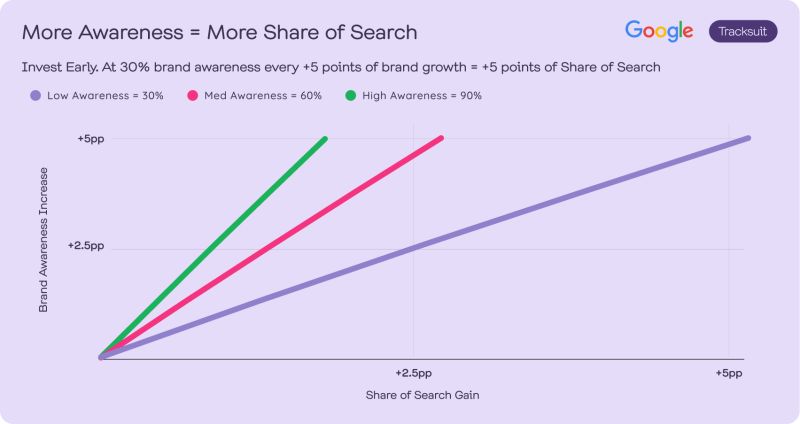
The specific numbers matter. For brands with roughly 30% awareness, each five-point increase in brand awareness produced approximately a five-point increase in share of search. That relationship held across low and mid-awareness brands, and the return was strongest for brands that invested early rather than waiting until they needed results.
The study also connects to earlier research by marketing effectiveness expert Les Binet, who found that changes in share of search tend to precede changes in market share by six to twelve months. So what you’re looking at is not just a correlation between awareness and search clicks. You’re looking at a leading indicator of where your market position is heading months before it shows up in revenue.

Source: Return on Awareness, Google and Tracksuit, 2026. At 30% brand awareness, every +5 points of brand growth equals +5 points of share of search gain.
Put plainly: if more people know who you are, more people search for you by name. And when three businesses show up in a search result, the one the searcher recognizes is the one they click. That is not a controversial idea. It is just math.
Why This Has Always Been Obvious and Nobody Cared
Intuition is not a budget line item.
I am not surprised by the findings of this study. Hopefully you aren’t either. I think we all know that this is true but what you know is different than what you can prove. The finding that people are more likely to click on a brand they recognize is not a revelation. It is common sense that has been systematically ignored because common sense doesn’t come with a dashboard.
The problem with brand awareness has never been that it doesn’t work. Attributing it directly to a sale in a way that satisfies someone who thinks marketing is a vending machine is the hard part. You put money in, a customer comes out. That’s not how any of this works, but it is the expectation that kills brand investment in company after company.
So marketers who advocated for it got overruled. Budgets went to performance channels that could show immediate attribution. And meanwhile, competitors who stayed visible kept compounding their search advantage, quarter after quarter, while everyone else wondered why their paid ads were getting more expensive and less effective.
Here’s the part that should actually sting: if your brand has low awareness right now, you are paying more for every customer you acquire. Lower awareness means lower share of search means less organic traffic means more dependence on paid. You are funding the gap that brand investment would have closed, just more expensively and with less to show for it.
Organic Social Media Is Not Dead. Stop Saying That.
Your customers are on social media right now.
Every few months someone publishes a take declaring organic social media dead. Reach is down, algorithms are hostile, nobody sees anything. Some of that is true. Organic reach is not what it was in 2016. But writing off organic social because it’s harder than it used to be is like stopping exercise because it got tiring.
Your customers use social media every day. I don’t care what industry you’re in. B2B, B2C, professional services, home services. The people who might buy from you are on social media. That is simply where people spend their time, and it is the one place you can reach them without a paid budget.
The goal of organic social is not to drive direct traffic to your website. Platforms don’t want that and they actively suppress posts with outbound links. The goal is to get seen and get remembered, which is exactly what the Google and Tracksuit study says matters. Consistent presence builds awareness. Awareness builds share of search. Share of search precedes market share. Every post you skip is a small tax on your future search performance.
Millions of views are not the goal. The right views are. A few hundred people in your target market seeing your name and your thinking, consistently, over months, builds something that a paid campaign turned on for two weeks cannot. If you want help getting that content right, the Social Media Copy AI Guide is a good starting point.
What This Means for the AI Search Era
Fewer results means the recognized brand wins more often.
The study raises something worth paying attention to beyond the immediate findings. AI-powered search surfaces one or two answers, not a page of ten blue links. When someone uses an AI search tool to find a solution to their problem, the brands most likely to appear are the ones those systems recognize as relevant and trusted.
That narrows the field dramatically. A traditional search result might surface a low-awareness brand through strong SEO alone. AI search results don’t work that way. Strong SEO is necessary but not sufficient. Familiarity and authority have to be there too. Brand awareness is not just a nice-to-have in that environment. Without it, AI search tools simply will not surface you.
The businesses that have been consistently building brand over the last few years are going to be significantly better positioned for AI search than the ones that cut brand investment to fund short-term performance campaigns. That gap is going to get harder to close over time, not easier.
How to Connect Awareness to the Four Gets
Brand awareness is not a separate strategy. It is the foundation of the first two steps.
We talk about the four gets of marketing: get seen, get remembered, get trusted, get purchased. Brand awareness is what fuels the first two. You cannot get remembered if you are not seen. And this study confirms that being seen and remembered carries directly into your search performance, which is where a lot of purchasing decisions start.
This is also worth saying plainly: brand awareness is not a substitute for a conversion strategy. Awareness without a clear path to purchase is just visibility. The study shows awareness drives share of search, and share of search precedes market share, but there are still steps between someone searching your brand name and someone paying you money. A good awareness strategy feeds those steps. It does not replace them.
If you’re not sure where your marketing is breaking down, whether it’s an awareness problem, a trust problem, or a conversion problem, that is exactly what we do. Take the free diagnostic and find out.
The Bottom Line
Brand awareness matters. It has always mattered. We now have a Google-backed study confirming that higher awareness drives higher share of search, and that share of search is a leading indicator of future market share. The CFO who cut the brand budget was not being fiscally responsible. That math has now caught up.
Start showing up consistently in the places your customers actually are. Organic social, content, email, community. Not because any single post is going to change your business, but because consistent presence compounds in ways that performance-only marketing cannot buy.
The study is out. That argument is over. Now is a good time to start building.
About the Author
Mike Birt
Mike Birt is Co-Founder and Lead Strategist at Big Brain Strategy. He has spent his career building marketing systems for businesses from startup to scale, with a focus on connecting acquisition, conversion, and retention to actual revenue. He believes most marketing problems are strategy problems in disguise.
Big Brain Strategy | The brains behind your growth. | bigbrainstrategy.com
Leave a Reply