
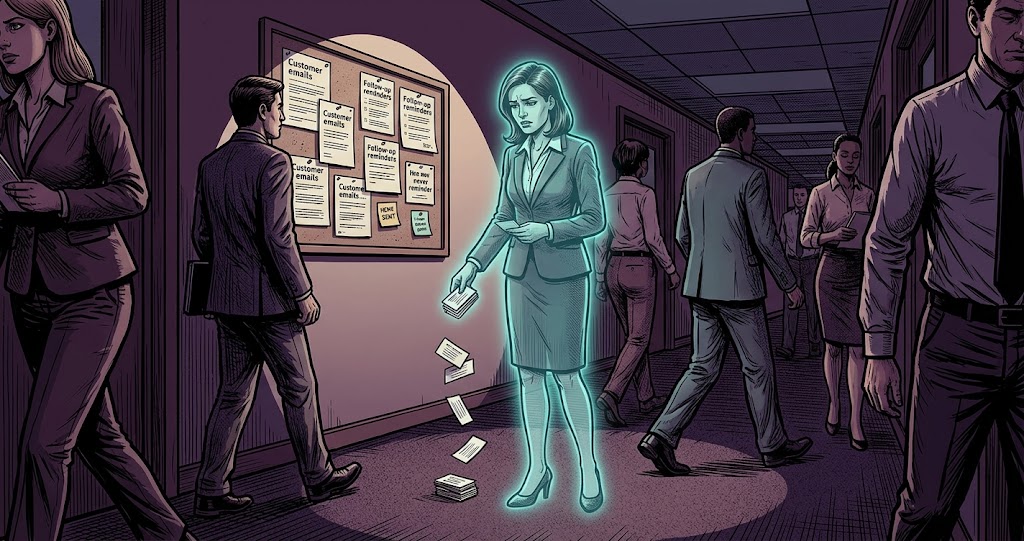
You Built Something Great. You’ve Been Invisible Ever Since.
The Ghost built a real business. The work is excellent. The clients are happy. Word of mouth has been enough, until recently. The referral network that built the business is aging. Growth has plateaued. And if you are honest about it, the customers who do find you rarely hear from you again after the first purchase or engagement.
The Ghost’s acquisition problem gets most of the attention. The fix, content, SEO, visibility, is what most marketing consultants focus on. But ghost business customer retention is equally important and far more fixable. It almost never gets addressed because everyone is so focused on getting new customers that nobody talks about keeping the ones already there.
Ghost businesses retain customers through inertia and excellence. When the product is good enough and the alternatives are unclear, customers stay. When a competitor appears, one that is equally good and actually communicates consistently, follows up, makes customers feel like a priority, they leave. Not dramatically. Quietly. The way Ghosts do.
The Ghost doesn’t lose customers to competitors with better products. They lose them to competitors who show up more consistently. Visibility is not just an acquisition strategy. It’s a retention strategy.
The Ghost’s Retention Reality: Invisible After the Sale
For most Ghost businesses, the post-purchase customer experience looks like this: the customer buys. They receive an order confirmation or service agreement. They get the product or service delivered. Then silence. Maybe a quarterly newsletter that goes out when someone remembers to write it. Maybe a follow-up call six months later. Maybe nothing at all.
This is the retention gap Ghosts do not see because the focus stays on the front end of the funnel. From inside the business, everything looks fine. The customer has not complained, has not cancelled, has not asked for a refund. From the customer’s perspective, the relationship stopped after the transaction. They are not a member of anything. They are not in a communication sequence. They do not feel retained. They feel purchased.
The difference between a retained customer and a purchased customer is the difference between a brand and a vendor. Ghost businesses are often excellent vendors. Customers rarely experience them as brands, because the relationship infrastructure, the emails, the SMS touchpoints, the loyalty program that signals ‘we value you,’ was never built.
Building Retention Visibility Without Becoming a Different Business
The Post-Purchase Email Sequence: Your First Retention Asset
The most important retention investment a Ghost business can make is a post-purchase email sequence. Research shows that automated post-purchase flows generate open rates between 40 and 45 percent, significantly outperforming standard marketing campaigns. The customer has just bought. They are engaged. That window does not stay open long.
A five-email post-purchase sequence for a Ghost business might look like this. Email one, sent immediately, confirms the purchase and sets expectations. Email two, sent three days later, delivers genuinely useful content related to what they bought. A how-to, a tip, a behind-the-scenes piece about how the product is made or the service is delivered. Email three, sent one week later, comes from a real person with a real question: how is everything going, is there anything I can help with? Email four, sent two weeks later, introduces something adjacent and relevant to their purchase. Email five, sent thirty days after purchase, asks for a review and offers something in return.
None of this requires a large marketing team. It requires writing five emails once and automating the trigger. Ghost businesses often frame their reluctance as not wanting to bother people. The data says otherwise: customers who receive post-purchase sequences buy again at meaningfully higher rates than customers who receive nothing.
Using Email to Build Relationship, Not Just Revenue
Ghost businesses that start email retention programs often make every email promotional. A sale. A new product. An announcement. These emails have their place, but a retention program built entirely on promotions trains customers to wait for discounts rather than building the relationship that makes them want to buy regardless.
A Ghost business email program needs three types of communication: relationship emails that deliver value with no ask attached, transactional emails that trigger from behavior, and promotional emails that the relationship the other two built has earned. If the email program runs at 80% promotional, that is email marketing. Balanced across all three, that is retention.
SMS: The Channel Ghost Businesses Underestimate
Ghost businesses often skip SMS entirely, either because it feels intrusive or because they have never done it before. Both hesitations are understandable. Neither reflects what the data says about SMS as a retention channel.
SMS open rates run above 90% and customers read messages within minutes of delivery in most cases. For a Ghost business with a warm customer base and a product or service worth talking about, SMS is the fastest path to re-engagement after a period of silence. Not a promotional blast. A relevant, personal message that makes the customer feel like the business is paying attention. A reorder reminder. A milestone acknowledgment. A genuine check-in. A value delivery that requires no purchase.
The right entry point for SMS in a Ghost business is small: a post-purchase confirmation, a delivery update, and a 30-day check-in. Three messages. Automated. Relevant. No discounts required. Expand from there once you know what customers engage with.
Loyalty Programs That Work for Service and Product Businesses
Ghost businesses often believe loyalty programs do not apply to them, either because transaction frequency is too low or because the referral-based model makes formal programs feel unnecessary. Both assumptions are worth challenging.
For lower-frequency transaction businesses, a loyalty program does not need to be points-based. It can be a VIP tier that unlocks early access, a referral reward that turns happy customers into advocates, or a membership model that formalizes the relationship and creates predictable recurring revenue. The goal is not a points accumulation system. The goal is a structured signal to best customers that their relationship with the business carries more weight than a one-time purchase.
Ghost businesses have something most businesses would pay for: a base of genuinely satisfied customers who simply have not been asked to do anything with that satisfaction. A loyalty structure, however simple, gives them a reason to deepen the relationship, refer a friend, and feel like they belong to something rather than having transacted with someone.
The SEO-Retention Connection Most Ghost Businesses Miss
The Ghost’s primary strategy usually focuses on SEO for acquisition: ranking for the problems the business solves, driving traffic to the site, converting that traffic. What rarely gets discussed is the SEO-retention connection, the way consistent content production keeps the Ghost visible to customers who already know them.
A customer who found the Ghost through search, bought, and now follows the brand will encounter the Ghost’s content again if it ranks for relevant searches. That second touch is not acquisition. It is retention. The customer gets a reminder that the brand exists, is still active, and still produces useful content about problems they care about. This is the flywheel Ghost businesses can build: visibility that drives acquisition and retention at the same time, because the content that attracts new customers also keeps existing ones engaged.
What Retention Looks Like When the Ghost Becomes Visible
When Ghost businesses build out their retention infrastructure, the post-purchase sequences, the SMS touchpoints, the loyalty structure, the effect on the referral network shows up fast. Satisfied customers who feel retained do not just return themselves. They refer. They review. They become active participants in the word-of-mouth flywheel the Ghost has always relied on but never systematically activated.
The Ghost who builds retention does not become a different business. They become a more visible version of the excellent business they already are. The product does not change. The service quality does not change. The customer’s experience of the relationship does. And that experience is what turns a satisfied buyer into a loyal advocate.
Find Out What’s Actually Keeping Your Business Invisible
The Ghost is one of eight marketing archetypes we have identified in businesses whose marketing is not working. If this resonates, the fastest path to clarity is the free marketing diagnostic at bigbrainstrategy.com/marketing-diagnostic. It takes five minutes, identifies your archetype, and tells you specifically what is driving your pattern and what it would take to change it.
About the Author
Nada Djuric is Co-Founder and Lead Retention Strategist at Big Brain Strategy, a marketing consultancy focused on turning customer behavior into revenue. She has spent two decades building and scaling retention systems for brands including Morningstar Inc., Kenneth Cole, Junk Food Clothing, and U.S. Cellular, growing email audiences into the millions and driving retention channels to approximately 30% of total revenue. She specializes in segmentation, lifecycle strategy, and fixing the gaps most brands ignore, usually the ones quietly costing them money.
Big Brain Strategy | The brains behind your growth. | bigbrainstrategy.com
Leave a Reply