
Your Brand Is Throwing a Party for the Wrong Moment.
The first sale gets the celebration. Conversion notifications. Revenue dashboards lighting up. Attribution reports showing which ad closed the deal. Teams optimize for it. Budgets revolve around it. Then the customer who just handed you money disappears into post-purchase silence while everyone moves on to acquiring the next one.
The second purchase is the moment that actually decides whether you have a customer or a transaction. And most brands have no plan for it. No post-purchase email sequence. No SMS strategy. No loyalty bridge. Just an order confirmation and a shipping update, both of which are logistics, not relationship.
That is the gap this post is about. If you are spending real money on acquisition and watching four out of five first-time buyers disappear, the fix is not more ads. It is a system for the 30 days after the sale.
The first sale proves your acquisition is working. The second sale proves your business is working. Most brands have a strategy for the first one and no plan for the second.
The Data Is Uncomfortable
Across ecommerce verticals, second-purchase conversion rates sit between 20 and 22 percent for beauty and apparel brands, according to Opensend’s benchmark research. Translation: roughly four out of five first-time buyers never come back. The industry average across all DTC categories lands around 25 to 30 percent, with luxury at the bottom of the range and consumables like grocery and pet at the top.
In fashion specifically, the median lifetime value curve flattens around five months. The window to convert a first-time buyer into a repeat customer is shorter than most brands realize, and the math on missing that window is brutal.
- Acquiring a new customer costs five to twenty-five times more than getting an existing one to buy again, per Shopify’s retention research.
- Repeat customers spend roughly 67 percent more per order than first-time buyers.
- The probability of selling to someone who has already bought from you is 60 to 70 percent. For a cold prospect, it is 5 to 20 percent.
So when a brand misses the second-purchase window, it is not a soft loss. It is the most expensive thing happening in the business that nobody has named.
What Actually Happens in the 30-Day Window
The 30 days after a first purchase are the highest-stakes stretch in your customer’s relationship with your brand. They just experienced your product. They are forming an opinion. They are deciding, consciously or not, whether you belong in their regular rotation or whether this was a one-time experiment.
During the same window, every other brand in your category is targeting them. Retargeting pixels are firing. Competitors are running ads. Referral-based alternatives are showing up in their feed. The customer who felt loyal at checkout is a prospect again, for everyone else who is paying attention.
Most brands miss this window completely. The post-purchase experience consists of an order confirmation and a shipping update. There is no brand-building. No value delivery. No bridge to the next purchase. The customer lands on the other side of 30 days with a product they may like, a vague memory of the brand, and no reason to return.
This is a strategy failure, not a product failure. The product did its job. The retention system never existed.
Building a Second-Purchase Strategy That Works
The Post-Purchase Email Sequence
The post-purchase email sequence is the single most important retention asset for driving second purchases. Not a newsletter. Not your promotional calendar. A deliberate, behavioral sequence built specifically for the customer who just bought from you for the first time.
The sequence has a job to do, in this order:
- Reinforce the buying decision and reduce buyer’s remorse.
- Deliver value that does not require another purchase.
- Introduce the rest of what you offer in a way that feels like discovery, not upselling.
- Create a natural pathway to the next purchase before the 30-day window closes.
Here is the structure that consistently lifts second-order rates.
- Email 1, within an hour of purchase: Confirm the decision was right. Not a transactional confirmation. A brand moment. “You made a great choice. Here is what to expect.”
- Email 2, day 3: Pure value. A how-to, a usage tip, a behind-the-scenes story, an insight the customer cannot get anywhere else.
- Email 3, day 7: A check-in from a real person. Plain text. No graphics. Reads like it came from a human, because it did.
- Email 4, day 14: Introduce something adjacent and relevant to what they bought. Not the rest of the catalog. The next logical thing.
- Email 5, day 25: Urgency without discount. “You haven’t been back. Here is what you might have missed.”
Five emails. One automated sequence. Built once, running for every new customer from the moment they buy. Finsi’s retention research tracking this specific pattern shows post-purchase sequences delivered within 14 days lift second-order rates by 20 to 35 percent on their own. That is the highest-impact retention asset available to most brands, and it sits behind a single piece of infrastructure most have never built.
SMS in the 30-Day Window
If your customer has opted into SMS, the post-purchase window is where it earns its place in your stack. Not as a promotional blast. As a precision instrument.
- A delivery confirmation with a personal note.
- A short tip related to their purchase a few days in.
- A loyalty update at day 14 showing them where they stand.
- A genuine check-in at day 21 that feels like it came from someone paying attention.
SMS open rates consistently exceed 90 percent, and messages are read within minutes of delivery. In the 30-day window, this is not a channel for volume. It is a channel for timing. Email builds the relationship over weeks. SMS accelerates the specific moments where timing changes the outcome. A customer on the fence about coming back gets an SMS on day 18 that surfaces exactly what they need to see. That is not automation for its own sake. That is precision retention.
The Loyalty Bridge
One of the most effective second-purchase drivers available to any brand is the loyalty bridge: the message that connects the first purchase to a reward the customer is already close to earning. “You’re 200 points away from your first reward” is not just an informational statement. It is a behavioral nudge backed by decades of research on goal completion and the endowed progress effect.
People are more motivated to finish a goal when they feel they have already made progress toward it. A loyalty program that surfaces progress inside the post-purchase window turns the second purchase from an abstract future event into the next step in a journey already underway. The customer is not just buying again. They are making progress. That framing changes the decision calculus in your favor.
The customer is not just buying again. They are making progress. That framing changes the decision calculus in your favor.
The Metrics That Tell You It’s Working
Two numbers matter. Track these monthly. Ignore vanity metrics that do not connect to repeat behavior.
- Repeat purchase rate within 90 days of first order. Not your overall repeat purchase rate. Specifically the conversion from first to second purchase inside a 90-day window, tracked by acquisition cohort. This number tells you whether your post-purchase sequence is doing its job faster and more accurately than any other measurement.
- Time-to-second-purchase. Average days between a customer’s first and second order. If your sequence is working, this number drops over time as more customers convert inside the 30-day window instead of drifting away.
Bain & Company research has shown that customers who buy again in their first year spend 67 percent more by months 31 through 36 than they did in their first six months. The second purchase is not just a second transaction. It is the start of the compounding relationship that makes your entire business more profitable over time.
What to Do With the Four Out of Five Who Didn’t Come Back
Most of your first-time buyers did not make a second purchase. They are not gone. They are lapsed. And they are one of the highest-conversion segments available to your retention program, because they have already shown enough trust to buy from you once.
A win-back sequence that activates 45 to 60 days after a single purchase should be a standard piece of your retention architecture. Not a promotional blast to the entire list. A targeted, behavioral sequence for the specific cohort of customers who bought once and never returned.
- Reference what they bought.
- Lead with value, not a discount.
- Make it feel like the brand noticed they were gone, because the brand should.
Even a 10 percent reactivation rate on this segment has meaningful revenue impact when you measure it against what acquisition would otherwise cost to replace those customers. The math almost always favors the win-back investment. Most brands never make it because the sequence was never built.
This Is What a Leaky Bucket Looks Like
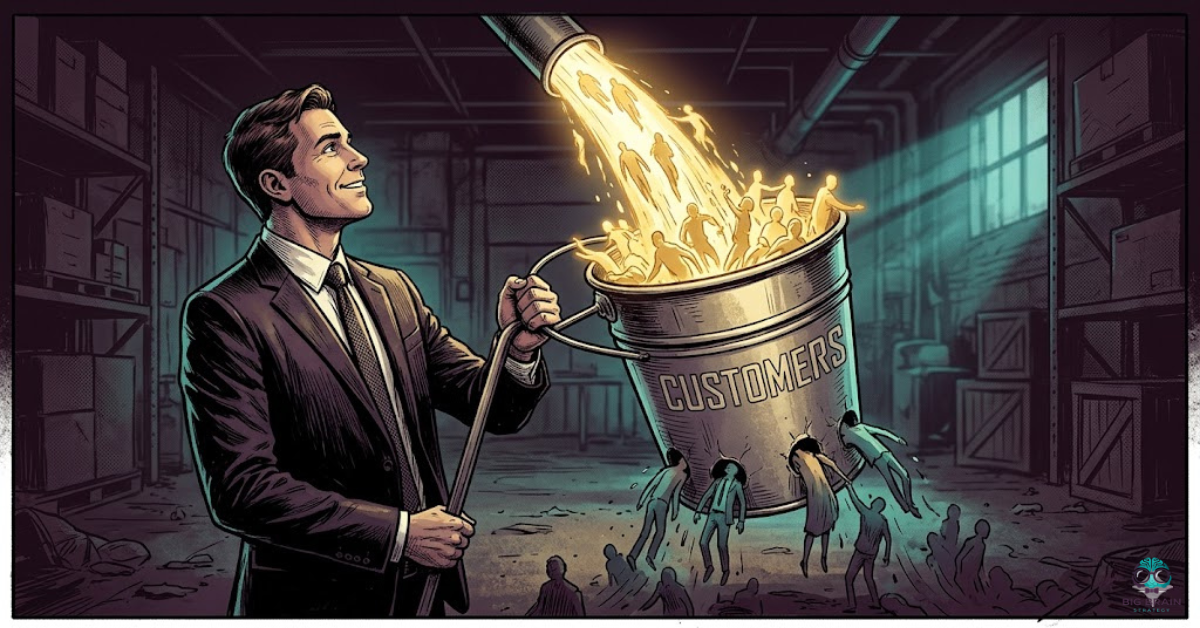
The pattern this post describes has a name. We call it the Leaky Bucket. It is one of eight marketing archetypes we have identified in businesses that are stuck. The Leaky Bucket business is good at acquisition and bad at retention, and the gap between those two things quietly drains the economics of the business until growth stalls or margins collapse.
The Leaky Bucket is not a product problem. The product is fine. Acquisition is fine. The bucket has holes in it because nobody built the system that would catch what is falling through. The post-purchase email sequence is the patch. SMS is the patch. The loyalty bridge is the patch. The win-back is the patch. None of it gets built by accident.
The Second Purchase Is a Strategy Decision, Not a Luck Decision
Brands that convert first-time buyers into repeat customers at above-average rates are not doing it by accident. They have made a deliberate decision to treat the 30-day post-purchase window as a strategic priority, build the infrastructure that serves it, and measure the outcome with the same rigor they apply to acquisition.
This is an engineering problem, not a creative problem. The creative matters. The emails need to be good. The SMS needs to feel human. The loyalty bridge needs to be compelling. But creative only works inside a structure that was intentionally designed. If you have no post-purchase strategy, the best copywriter alive cannot save the relationship that was never continued.
If you have no post-purchase strategy, the best copywriter alive cannot save the relationship that was never continued.
Find Out If This Is Your Pattern
If your acquisition is working but your repeat rate is flat, the diagnosis matters before the fix. The free marketing diagnostic at bigbrainstrategy.com/marketing-diagnostic takes about five minutes and identifies which of the eight patterns your business is actually in. If you suspect Leaky Bucket, this will confirm or correct the read in five minutes, which is less time than it takes to sit through one more meeting about why CAC keeps climbing.
→ Take the free marketing diagnostic at bigbrainstrategy.com/marketing-diagnostic
About the Author
Nada Djuric is Co-Founder at Big Brain Strategy. She has built retention programs that doubled email’s contribution to total company revenue from 15 percent to 30 percent, grew SMS programs from zero to two million opt-ins, and lifted ecommerce winback retention by 32 percent. Strategy must work inside real-world margins. That is the lens she brings to every engagement.
Big Brain Strategy | The brains behind your growth. | bigbrainstrategy.com
Leave a Reply